O- and B-Type Stars
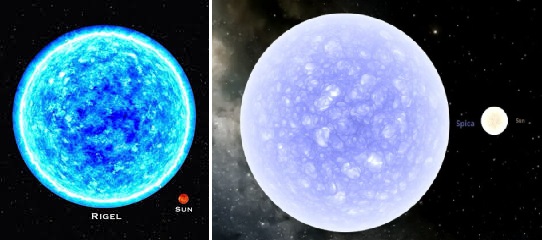
O- and B-type stars include the hottest, brightest, and shortest-lived stars in spectral classification. In terms of surface temperature and the amount of energy they emit, these stars stand apart from all other spectral classes by a wide margin. Although they are rare in number, they strongly influence their surroundings and play a major role on galactic scales. O- and B-type stars are among the clearest indicators of star-forming regions and young galactic structures.
B-type stars are somewhat cooler than O-type stars, yet they still have extremely high surface temperatures. These temperatures generally fall between about 10,000 and 30,000 degrees. For this reason, B-type stars appear blue-white. Their intense ultraviolet radiation can ionize surrounding gas and lead to the formation of bright glowing gas clouds in the regions where they reside. B-type stars are considered young and energetic stars.
As an example of a B-type star, Rigel in the constellation Orion is one of the famous stars in this class. Rigel stands out as extremely bright in the sky and reflects typical properties of B-type stars through its high mass. Similarly, Spica is also among the B-type stars and can be easily distinguished by its blue-white light. Stars of this kind are often found within young star clusters.
O-type stars, on the other hand, lie at the extreme end of the spectral system. Their surface temperatures can exceed 30,000 degrees and in some cases reach much higher values. This extreme temperature causes O-type stars to emit intensely blue light. These stars are among the most massive stars in the universe, and nuclear reactions in their cores occur at an exceptionally rapid rate. While this greatly increases their energy output, it also drastically shortens their lifetimes.
Examples of O-type stars include Zeta Puppis and Theta¹ Orionis C. These stars are found in young star-forming regions and shape the surrounding gas and dust clouds through their powerful radiation. The presence of O-type stars typically indicates that star formation has occurred in that region relatively recently. For this reason, O-type stars are important signposts for astronomers.
One of the most striking characteristics of O- and B-type stars is how short-lived they are. Because of their large masses, they consume their core hydrogen fuel extremely quickly. These stars remain on the main sequence for only a few million years—an extremely short time by cosmic standards. By contrast, stars like the Sun can remain stable for billions of years. This difference clearly shows how decisive mass is in stellar evolution.
The ends of these stars’ lives are also extremely violent. O- and B-type stars can reach enormous sizes in their later evolutionary stages, and once their core fuel is depleted, the balance breaks down. This process often ends with the star ejecting its outer layers in a massive supernova explosion. During such explosions, heavy elements are dispersed into space, contributing to the formation of new stars and planets.
After the supernova, the remaining core becomes a different kind of object depending on the star’s initial mass. Lower-mass remnants can become extremely dense neutron stars, while at very high masses the core continues collapsing and a black hole forms. For this reason, O- and B-type stars are among the origins of the most extreme and extraordinary objects in the universe.
In conclusion, O- and B-type stars play a key role in the evolution of the universe despite being relatively rare. With their high temperatures, powerful radiation, short lifetimes, and violent deaths, they profoundly affect the galactic environment. Understanding O- and B-type stars means understanding star-forming regions, the origins of heavy elements, and the foundations of cosmic events such as supernovae.