How Do Stars Form?
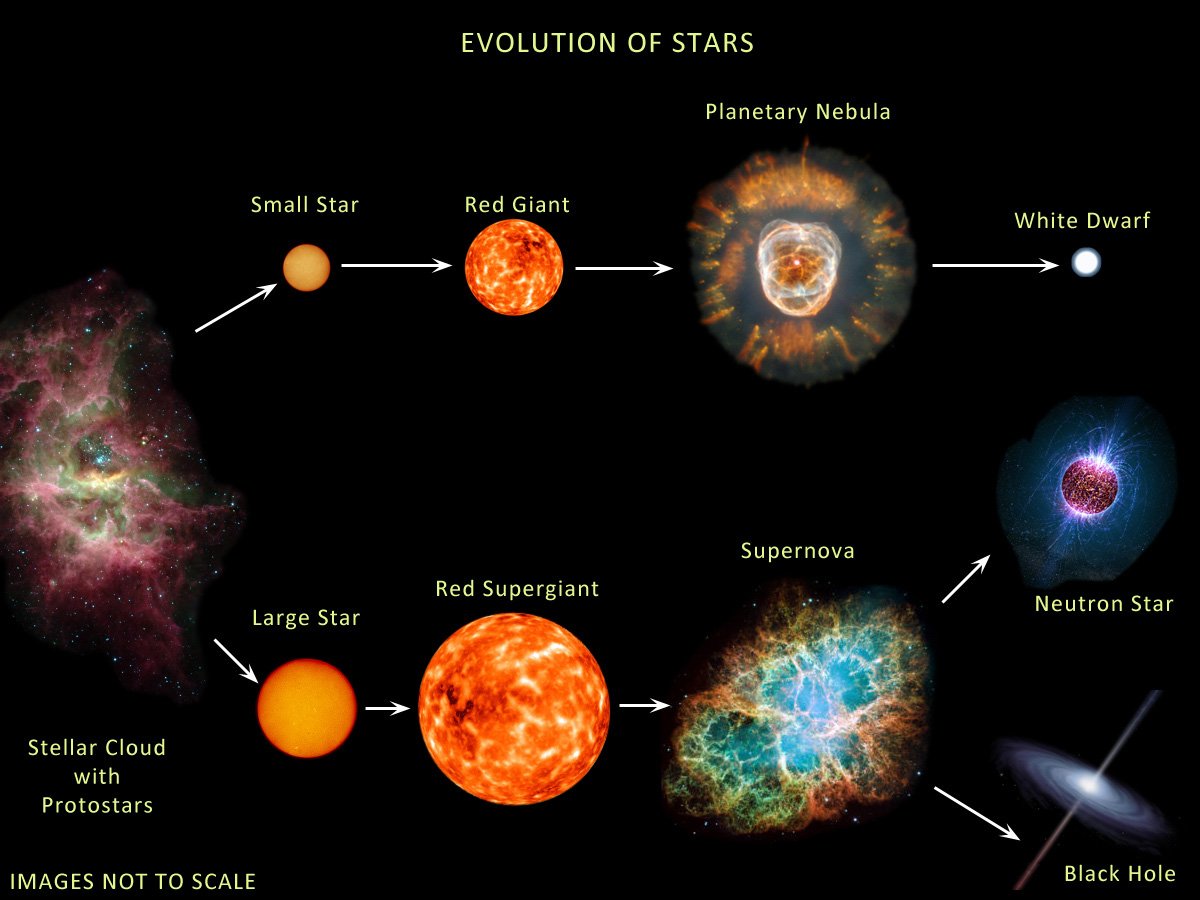
The formation of stars is not just a single moment of birth; it is also the beginning of a long life cycle that can last for billions of years. Understanding how a star forms requires considering how it lives and how it dies as part of the same story. For this reason, star formation is treated as a process that effectively includes the full scope of stellar evolution.
A star’s birth begins inside cold and dense gas clouds found within galaxies. These clouds consist largely of hydrogen gas and cosmic dust. Under normal conditions, such clouds can remain in balance, but an external influence may cause the density to increase in a particular region. Once this concentration begins, gravity becomes dominant and the gas slowly starts collapsing inward under its own weight.
As the collapse continues, gas and dust gather in the center and the temperature rises. At this stage, a star has not yet formed. The structure that appears is called a protostar. While the protostar continues pulling in material from its surroundings, it also begins to rotate. This rotational motion creates a disk-like structure around the forming star. In later stages, this disk can become the foundation for planetary systems.
As the protostar grows, the pressure and temperature in its core steadily increase. When the core temperature approaches millions of degrees, it reaches a critical threshold where nuclear reactions between hydrogen atoms are about to begin. At this point, a balance is established between internal pressure and gravity. Once energy production begins as hydrogen turns into helium, the protostar becomes a true star. This is the moment the star is born.
At this stage the star enters the longest and most stable period of its life. In this phase, it burns hydrogen in its core and releases a steady flow of energy outward. The Sun is currently a star in this stage. Depending on a star’s mass, this period can last millions or billions of years. However, from this point forward, the star’s fate diverges according to how much mass it has.
In low- and medium-mass stars, the hydrogen in the core is eventually depleted. As energy production decreases, the core begins to contract. During this contraction, the outer layers expand and the star enters the red giant phase. In this stage the star becomes enormous, while its surface temperature drops. The Sun is a star that will enter this phase in the future.
In the red giant phase, the star begins to shed its outer layers into space. Over time, a large expanding shell of gas forms around it. This structure is called a planetary nebula. A planetary nebula is a short-lived formation created from the last material the star releases into space. At the center of this nebula, the star’s dense core remains behind.
The lives of low- and medium-mass stars end in the white dwarf stage. A white dwarf is an extremely dense and hot core in which nuclear reactions no longer occur. Over time it cools and fades. This happens over very long timescales. A white dwarf is a quiet but lasting remnant left behind by a star.
The evolution of high-mass stars is far more violent. These stars consume their core fuel very rapidly. After hydrogen is exhausted, they begin burning heavier elements. This process continues until iron forms in the core. Because iron fusion does not provide energy, the balance collapses and the core suddenly falls inward.
This sudden collapse causes the star’s outer layers to be blasted into space in a massive explosion. This event is called a supernova. A supernova is among the most energetic events in the universe and it spreads heavy elements outward into space. The remaining core is transformed into different kinds of objects depending on the star’s mass.
If the core’s mass is below a certain limit, an extremely dense neutron star forms. At even higher masses, the core continues collapsing inward and a black hole is created. These objects represent the final stage of massive stars and they contain some of the most extreme physical conditions found in the universe.
In conclusion, the formation of stars is a complex process that begins with gas and dust and leads to gigantic bodies that generate nuclear energy. Depending on mass, this process branches into very different life paths. Small stars fade quietly, while massive stars end their lives with explosions that shake the universe. Understanding how stars form is a key to understanding how matter is transformed in the cosmos and how today’s cosmic structure came to be.