How Do Galaxies Form?
The formation of galaxies is the result of a long and complex process that reaches back to the earliest eras of the universe. After the Big Bang, the universe expanded rapidly and matter was distributed in a nearly uniform way. However, this distribution was not perfectly smooth. Tiny differences in density grew over time under the influence of gravity and became the foundation of the universe’s large-scale structures. The origin of galaxies rests on these initial density fluctuations.
As the universe cooled, matter gradually began to gather under gravity. Dark matter played a decisive role in this process. Although dark matter does not interact directly with light, its strong gravitational influence formed massive structures. These structures acted like a framework for the regions where galaxies would develop. Ordinary (visible) matter—gas and dust—was pulled into these dark-matter concentrations.
As gas clouds were compressed inside these dark-matter halos, their density increased and the first stars began to form. These early stars were much larger and shorter-lived than many stars seen today. They quickly ended their lives and scattered heavy elements into their surroundings. Those elements provided the raw material needed for later generations of stars and for the development of more complex galactic structures.
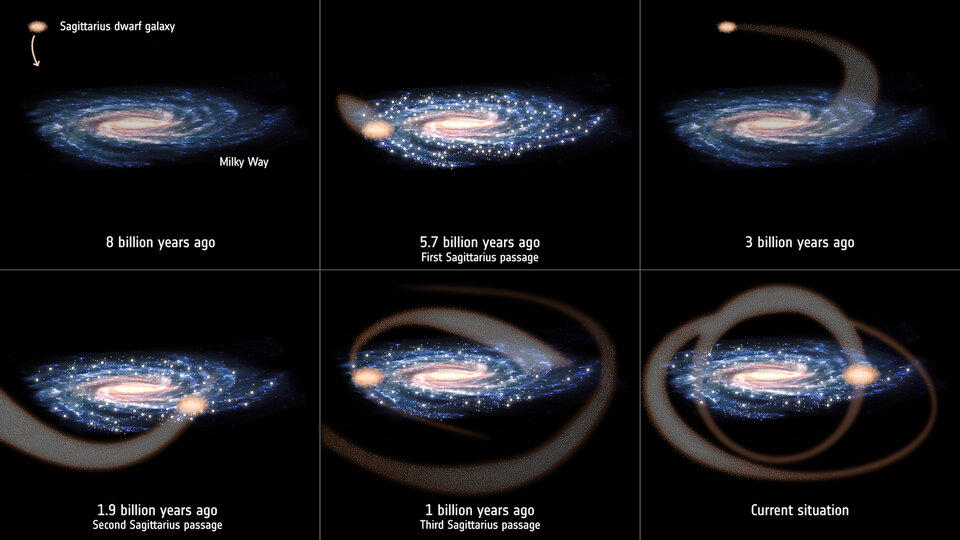
Over time, small proto-galactic structures emerged. These first galaxies were relatively small compared with the large galaxies observed today. But galaxy formation is not a static process. Gravity caused these small galaxies to draw closer and merge over time. Galaxy mergers became one of the main mechanisms by which galaxies grew and took shape.
The reason galaxies come in different forms lies in the interactions experienced during formation and evolution. Some galaxies developed in relatively calm environments and achieved more orderly structures, while others underwent frequent collisions and mergers, becoming more irregular or more elliptical in shape. The amount of gas, the rotation rate, and environmental effects are among the main factors that determine which class a galaxy belongs to.
Rotation plays a critical role in galaxy formation. As a gas cloud collapses, it conserves angular momentum and begins to rotate more strongly. This rotation can cause gas to spread into a flat disk. In such environments, star formation occurs across the disk and spiral patterns can develop. By contrast, in environments dominated by violent collisions, galaxies tend to become rounder and more disordered.
Galaxy formation is not only a phenomenon of the distant past. Even today, galaxies continue to form, grow, and change in the universe. Observations of distant galaxies show that galaxies in the young universe were more irregular and experienced more intense star formation. Over time, these systems matured, producing the variety of galaxy types seen today.
In conclusion, galaxy formation is a multi-stage process in which dark matter provides the guiding structure, gas collapses, stars are born, and galaxies grow through mergers. This is a cosmic evolution that has continued from the universe’s earliest moments to the present day. Understanding how galaxies form is the key to understanding how the universe’s large-scale structure—and its present appearance—came into existence.