Spiral Galaxies
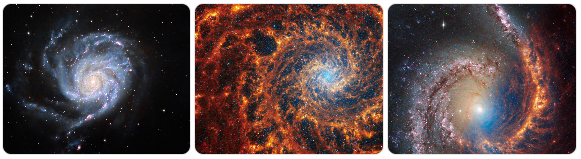
Spiral galaxies are disk-shaped galaxies with distinct arms that curve outward from the center. These arms consist of denser regions of stars, gas, and dust shaped by the galaxy’s rotation. The spiral pattern is a direct result of the galaxy’s internal dynamics and rotational motion.
A flat disk structure dominates these galaxies. At the center of the disk lies a brighter, denser core region. Extending outward, the spiral arms are areas where young and hot stars are especially concentrated. Star formation remains actively ongoing in these regions. This makes spiral galaxies dynamic systems rich in gas and dust.
In spiral galaxies, stars and gas orbit the galactic center mostly within the same plane and along relatively orderly paths. This organized motion helps spiral arms persist over long periods. However, interactions between galaxies, tidal forces, and internal dynamics can change the shape of these arms over time.
One of the best examples of a spiral galaxy is Messier 101, which represents a classic spiral structure with clear and symmetric arms. Similarly, NGC 628 is another typical spiral galaxy that does not show a bar structure, and because it is seen face-on, its spiral arms can be observed clearly. NGC 1566 also displays characteristic traits of this class with distinct arms and active star-forming regions.
A shared feature of these spiral galaxies is the absence of a prominent central bar. Their spiral arms begin directly from the central core region. This is the key structural difference that separates them from barred spiral galaxies and is important in morphological galaxy classification.
One point that should be emphasized is that the Milky Way Galaxy is not included in this specific class. Because the Milky Way contains a noticeable bar-like structure at its center, it is classified not as a “pure” spiral galaxy but as a barred spiral galaxy. For that reason, the Milky Way is not an example of spiral galaxies here, but rather belongs to the next class.
In conclusion, spiral galaxies stand out with their orderly disk structures, prominent spiral arms, and active star formation. It is thought that many planetary systems capable of supporting life may be located within galaxies of this type. Spiral galaxies are among the key observational targets for understanding galaxy dynamics and star formation processes.