Barred Spiral Galaxies
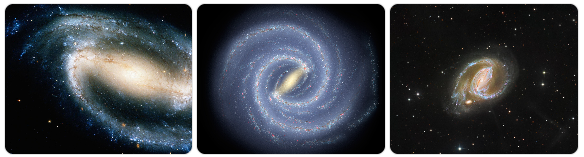
Barred spiral galaxies form a special subclass of spiral galaxies. In these galaxies, there is a straight, linear structure made of stars that passes through the central region. This structure is called a “bar,” and it is the most distinctive feature of the galaxy. The spiral arms begin at the ends of the bar and curve outward. Because of this, barred spiral galaxies differ clearly in structure from pure spiral galaxies.
The formation of the bar is closely linked to the galaxy’s internal dynamics. Stars and gas moving within the disk can develop instabilities over time. These instabilities can cause stars in the central region to collect along a linear structure. The resulting bar reshapes the distribution of matter inside the galaxy and plays an active role in the galaxy’s evolution.
Gas motions in barred spiral galaxies differ from those in pure spiral galaxies. The bar can act like a channel that directs gas toward the galaxy’s center. This can increase star formation in the central region and make the core more active. As a result, barred spiral galaxies can show intense star formation in their inner zones.
One of the best examples of a barred spiral galaxy is NGC 1300. It has a highly prominent and symmetric bar and is considered a classic representative of barred spirals. Similarly, NGC 7753 clearly displays the characteristic features of barred spirals with its distinct central bar and orderly spiral arms that begin at the bar’s ends. NGC 7753 is an important example of how the bar shapes a galaxy’s overall symmetry and the organization of its arms.
The Milky Way Galaxy is also classified today as a barred spiral galaxy. For many years, the Milky Way was thought to be a pure spiral galaxy. However, infrared observations in particular have revealed a distinct bar-like structure made of stars in our galaxy’s center. This bar extends in two directions across the central region, and the spiral arms begin from the ends of this structure.
Classifying the Milky Way as barred spiral is an important example of how galaxy morphology can change based on observational data. Although the Milky Way’s inner structure is difficult to observe in visible light because of dust, studies at different wavelengths strongly support the existence of the bar. This shows that galaxy classifications can be updated over time.
Barred spiral galaxies are very common in the universe. Observations indicate that a significant fraction of disk galaxies show a bar structure. This suggests that bar formation is not an exception, but a natural outcome of galaxy evolution. Bars are considered one of the key features that transform galaxies internally and guide their long-term evolution.
In conclusion, barred spiral galaxies represent a more complex and dynamic form of spiral galaxies. Their central bars play a critical role in galaxy evolution because they redirect gas flows and influence star formation. The fact that the Milky Way belongs to this class shows that barred spiral galaxies are not only part of the distant universe, but also a fundamental part of our own cosmic environment.