Dark Nebulae
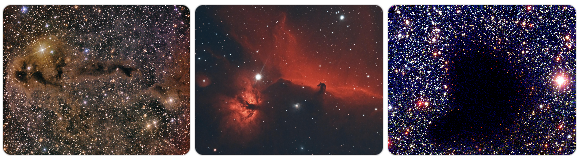
Dark nebulae are types of nebulae found in interstellar space that appear as dark silhouettes by absorbing light coming from their surroundings. These nebulae do not produce their own light and are usually seen as black patches in front of bright stars or luminous nebulae. Their dark appearance does not mean they lack matter; on the contrary, dark nebulae are among the densest and most matter-rich structures in interstellar space.
The main components of dark nebulae are gas and cosmic dust. Dust particles, in particular, are the defining feature of these nebulae. This dust consists of microscopic solid particles that absorb visible light coming from stars. By blocking this light, the nebula makes the stars and bright regions behind it difficult to see. For this reason, dark nebulae can give the impression that there is an empty void in the sky.
Physically, dark nebulae are colder and denser than many other types of nebulae. The temperature inside them is quite low, allowing the gas to remain bound together for long periods. Low temperature combined with high density enhances the effect of gravity. For this reason, dark nebulae are considered environments where the earliest stages of star formation take place. In these regions, which do not yet shine or emit light, the stars of the future begin to take shape in silence.
The internal structure of dark nebulae is not uniform. Some regions are significantly denser than others, and these areas begin to collapse over time. As the collapse progresses, gas and dust become increasingly compressed, central density rises, and the first steps of star formation begin. Since no visible star or bright nebula has formed at this stage, the process cannot be directly observed. This explains why dark nebulae are both challenging and extremely important in astronomy.
Dark nebulae are often found as parts of larger nebular complexes. When located in front of bright emission nebulae, their shapes become much more distinct. The structure known as the Horsehead Nebula in the constellation Orion is one of the most famous examples of a dark nebula, appearing as a dark silhouette against a bright emission nebula. In addition, LDN 1250 and Barnard 68 are also well-known examples. Similarly, some dense dust regions around the Eagle Nebula block the bright gas in the background and display typical dark nebula appearances. Thanks to this contrast, certain dark nebulae form characteristic and recognizable shapes.
These nebulae are not only the starting points of star formation but also play a role in the structural evolution of galaxies. Dark nebulae influence how gas and dust are distributed within galaxies and determine where new stars will form. Their concentration along the spiral arms of galaxies explains why star formation is more active in those regions. In this sense, dark nebulae have a regulating effect on a galactic scale.
Over time, as new stars form within the dense regions of dark nebulae, the surrounding conditions change. When newly born stars begin emitting energy into their environment, some parts of the nebula become illuminated and cease to appear dark. This transformation can cause a dark nebula to evolve into another type of nebula. In this way, dark nebulae represent a quiet but fundamental stage of the cosmic matter cycle.
In conclusion, dark nebulae symbolize the hidden and unseen beginning phase of star birth in the universe. Although they may appear as empty voids at first glance due to their light-blocking nature, they actually contain the raw material for future stars and planetary systems. These nebulae are among the clearest examples of the deep and long-lasting physical processes that operate behind the visible light of the universe.