Planetary Nebula
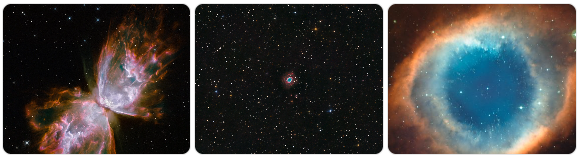
Planetary nebulae are a type of nebula formed during the final stage in the lives of stars with masses similar to the Sun or somewhat larger. Their name comes from the fact that, when first observed with small telescopes, they showed round shapes resembling planets; however, they have no physical connection to planets. These nebulae consist of material expelled into space during the death of a star and represent a late phase of stellar evolution.
The formation of a planetary nebula begins when a star exhausts its fuel. A Sun-like star spends most of its lifetime burning hydrogen and later helium in its core. When this fuel is depleted, the star becomes unstable and its outer layers begin to expand. The star enters the red giant phase and sheds large amounts of gas into its surroundings. During this process, the outer layers are gradually pushed outward into space, forming an expanding обол shell of gas around the star.
At the star’s center, an extremely hot and dense core remains. Even though this core no longer produces nuclear fuel, it retains a very high temperature. This heat causes it to emit intense radiation. The gas that was expelled and spread into space is illuminated by this radiation, producing the characteristic bright appearance of a planetary nebula. At this stage, the remaining core becomes a very dense object known as a white dwarf.
Planetary nebulae often display symmetrical and orderly structures. They can appear as rings, shells, ellipses, or even more complex patterns. These shapes depend on the speed and direction of the ejected material and on the star’s rotation. The Ring Nebula, which appears ring-shaped from Earth’s viewpoint, is one of the most famous examples of such structures. Similarly, the Helix Nebula in the constellation Aquarius—also known in Turkish as the “Salyangoz Nebula”—shows a typical planetary-nebula appearance with its expanding gas shell and complex internal structure. While some planetary nebulae form remarkably smooth, almost perfect circles, others exhibit filamentary features and layered rings.
The gas within planetary nebulae is typically at high temperature and is ionized. This ionization causes the nebula to glow in different colors. The chemical composition of the gas directly influences the nebula’s appearance. Elements such as hydrogen, oxygen, and nitrogen are the main sources of the emitted light. For this reason, planetary nebulae are important structures that show how elements produced inside stars are dispersed into space.
On cosmic timescales, planetary nebulae are relatively short-lived. A planetary nebula remains bright for a comparatively brief period—on the order of tens of thousands of years. Over time the gas disperses into space, its density decreases, and the nebula fades from view. Only the white dwarf remains. This short lifetime explains why planetary nebulae are rare in the universe, yet highly valuable for astronomical study.
Planetary nebulae play an important role in the recycling of matter in the universe. Heavy elements produced in the star’s interior are mixed into the interstellar medium through these nebulae. Later, this material can be used in the formation of new stars, planets, and even chemical compounds essential for life. In this sense, planetary nebulae are structures that begin with the death of a star but create the conditions for new formation.
In conclusion, planetary nebulae reveal one of the final scenes of stellar evolution. As a star’s life ends, the material it releases forms a short-lived yet striking visual structure within the darkness of space. These nebulae clearly demonstrate that stars produce not only energy, but also the chemical richness of the universe.