Giant Stars
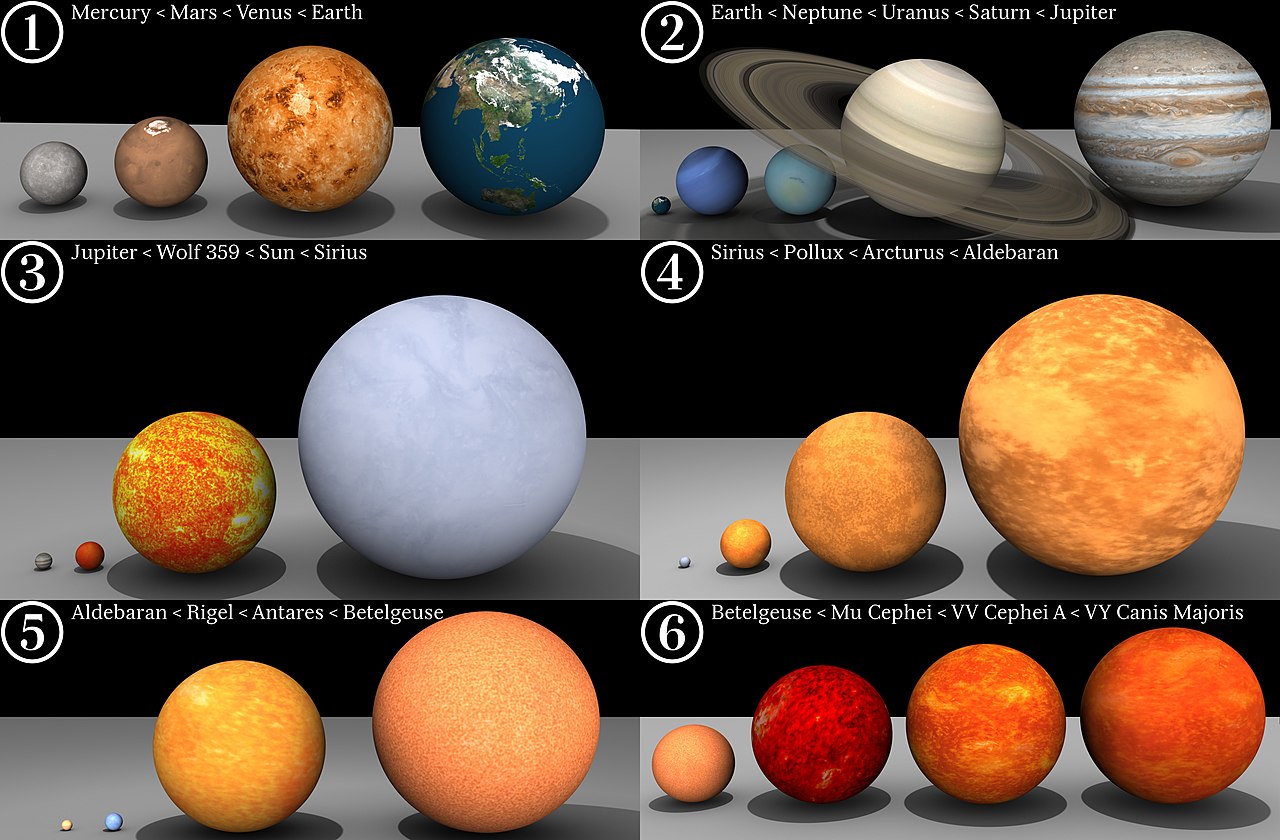
Giant stars are stars that have reached a particular stage in stellar evolution and expanded to extraordinary sizes. They are defined independently of spectral classification; in other words, the term “giant” refers not to temperature or color, but to the star’s physical size and evolutionary state. When a star becomes a giant, its diameter can grow to tens or even hundreds of times its original size. However, its mass does not increase by the same factor; the star mainly expands and becomes more diffuse.
Giant stars are stars that have completed their main-sequence phase. When hydrogen fuel in the core is depleted, the balance of energy production is disrupted. While the core begins to contract, the star’s outer layers expand in response. This expansion turns the star into a giant. Because the surface area becomes enormous, the star’s luminosity increases, but the surface temperature generally decreases. For this reason, many giant stars appear red or orange in color.
Low- and intermediate-mass stars enter the red giant stage in later phases of their lives. In these stars, the core begins burning helium instead of hydrogen. This process leads to major changes in the star’s internal structure. The Sun is also a star that will enter the red giant stage in the future. In this phase, it can expand enough to affect even the inner regions of its planetary system.
As examples of giant stars, Aldebaran in the constellation Taurus is among the red giants. It can be easily recognized in the sky by its orange-tinged color. Similarly, Arcturus in the constellation Boötes can also be given as an example of a giant star. These stars stand out with their large diameters and high luminosities. Even though their diameters can be dozens of times larger than the Sun’s, their surface temperatures are lower than the Sun’s.
High-mass stars, however, reach the giant stage through a very different route. These stars complete the main-sequence phase quickly and soon become supergiant stars. Supergiants are far larger than giants. Their diameters can reach hundreds or even thousands of times the Sun’s. Although they are extremely luminous, their internal structures are highly unstable.
As an example of a supergiant, Betelgeuse in the constellation Orion can be mentioned. Betelgeuse is a red supergiant and is bright enough to be seen with the naked eye. Similarly, Antares is also among the supergiant stars. Because these stars are very close to the ends of their lives, they are of great interest to astronomers.
Giant and supergiant stars play an important role in the chemical evolution of the universe. Heavier elements are produced inside these stars, and in their final evolutionary stages these elements are released into space. Low-mass giant stars shed their outer layers gradually, whereas high-mass supergiants end their lives in violent supernova explosions. These explosions disperse heavy elements throughout galaxies.
Giant stars do not remain stable for long. This phase is a temporary but dramatic stage in a star’s life. For low- and intermediate-mass stars, the giant phase is the beginning of the path leading to the planetary nebula and white dwarf stages. For high-mass stars, the giant phase signals the process that leads to a supernova and then to the formation of a neutron star or a black hole.
In conclusion, giant stars represent one of the most spectacular stages of stellar evolution. With their extraordinary sizes, high luminosities, and their roles in producing heavy elements in the universe, they are of great importance on a cosmic scale. Studying giant stars provides a fundamental key to understanding how stars change near the ends of their life cycles and how the chemical richness of today’s universe has been created.