Planets
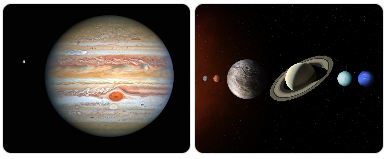
Planets are large celestial bodies that orbit a star and have taken on a spherical shape thanks to their own gravity. All planets in the Solar System move along specific orbits under the gravitational influence of the Sun. These motions are not random; the planets’ orbits reflect the direction and order of the rotating disk of gas and dust from which the system originally formed. Planets do not produce their own light, but they become visible in space by reflecting the sunlight they receive.
The planets in the Solar System show clear differences depending on their structure. The planets closer to the Sun are smaller, denser, and rocky. Their surfaces are made of rocks and metals. For example, Mars is a planet known for its reddish color, its thin atmosphere, and the traces of ancient volcanic activity on its surface. Mars has two small moons, called Phobos and Deimos. In mythology, these names refer to fear and terror, inspired by Mars’s association with war. These small moons are striking examples of how diverse the bodies orbiting a planet can be.
Another planet closer to the Sun, Earth, stands apart from the others because it holds liquid water on its surface. Earth has a single natural satellite, and this moon has a significant influence on the planet’s axial tilt and rotational behavior. The presence of the Moon has played a role not only in Earth’s day–night cycle but also in stabilizing climate over long timescales. This shows how strongly planet–moon relationships can affect a planet’s evolution.
Planets located farther from the Sun have reached much larger sizes. These planets possess thick atmospheres and strong gravitational fields. For instance, Saturn is famous for its wide and prominent ring system. Saturn’s largest moon, Titan, is remarkable because it has a thick atmosphere. Titan also contains liquids on its surface, showing that moons can be as complex and varied as planets themselves.
Planets also differ greatly in temperature. Planets close to the Sun are exposed to high temperatures, while distant planets exist in extremely cold environments. These temperature differences shape planetary atmospheres and surface structures. Rocky surfaces dominate the inner planets, whereas gas and fluid layers are more prominent in the outer planets. This reveals how the conditions of a planet’s formation environment directly influence its present-day appearance.
Every planet rotates around its own axis, creating the cycle of day and night. At the same time, the shape of a planet’s orbit and the tilt of its axis cause seasonal changes. These characteristics vary widely from planet to planet. On some planets, days can be extremely long, while on others rotation is very rapid. This diversity clearly demonstrates how different planetary physical properties can be.
Moons, rings, and other smaller bodies surrounding planets add to the complexity of planetary systems. Some planets have dozens of moons, while others have none. These moons provide important information about planetary formation history and gravitational effects. At the same time, these subsystems around planets show that the Solar System is not made up of planets alone.
In conclusion, planets are among the most striking and diverse members of star systems. The range from rocky worlds with solid surfaces to giant gas planets reveals that the universe does not contain only one kind of planet. Studying planets in detail is essential for understanding how star systems form, how they change over time, and what kinds of worlds can emerge under different conditions.