How Do Neutron Stars Form?
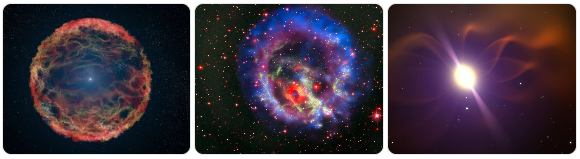
The formation of neutron stars is an extremely violent and brief process that only very massive stars can experience. It begins when the nuclear reactions in a star’s core come to an end. Throughout its life, a massive star produces energy by fusing hydrogen, helium, and progressively heavier elements in its core. This energy supports the star against its own gravity and keeps it in balance.
Over time, the star’s nuclear fuel is exhausted. In massive stars, this process continues until iron is produced. Iron does not release energy through fusion in a way that can support the star. Once iron starts accumulating in the core, energy production effectively stops and the star’s internal balance collapses. At that point, the star can no longer support its own weight, and the core undergoes sudden collapse.
Core collapse happens incredibly fast. Within seconds, the star’s center shrinks dramatically and its density rises to extraordinary levels. During this collapse, protons and electrons are forced together by immense pressure and transform into neutrons. This creates the neutron-rich core that becomes the foundation of a neutron star. At the same time, an enormous amount of energy is released.
While the core collapses, the star’s outer layers cannot follow the motion instantly. Material falling inward slams into the newly formed dense core like it has struck a hard surface, then rebounds and is blasted outward into space. This “bounce” helps drive a supernova explosion. During the supernova, the star’s outer layers are ejected at tremendous speeds, while an extremely dense core remains at the center.
If the collapsing core’s mass is below a critical limit, the collapse stops at this stage and a neutron star forms. Quantum-origin repulsive forces between neutrons prevent further compression. Thanks to this balance, the core does not continue collapsing into a black hole and instead becomes a stable neutron star.
If the core’s mass exceeds this limit, neutron pressure is not enough to stop the collapse. In that case, the collapse cannot be halted and the core becomes a black hole. This explains why massive stars can leave behind either neutron stars or black holes: neutron stars mark the critical boundary between these two outcomes.
Immediately after formation, a neutron star is extremely hot and energetic. Its surface temperature can reach millions of degrees. Over time it cools, but it can continue emitting high-energy radiation for a very long period. Its spin rate and magnetic field are also largely determined by the conditions present during its birth.
A neutron star’s rapid rotation is explained by the conservation of angular momentum during collapse. As the core suddenly shrinks, its rotation speed increases dramatically. This can set the stage for some neutron stars to become pulsars—objects that emit signals at regular intervals. Magnetic fields are also thought to be greatly amplified during this phase.
In conclusion, neutron stars form through a dramatic sequence that begins with the death of a massive star and completes within seconds. Alongside supernova explosions—events that inject energy and heavy elements into the universe—this process leaves behind one of the densest objects known. Neutron stars are the enduring and extraordinary remnants of that violent stellar finale.