Elliptical Galaxies
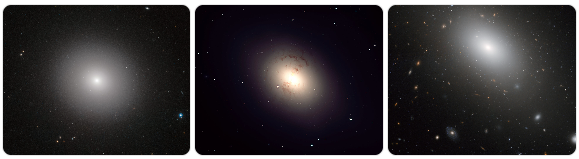
Elliptical galaxies are among the largest and oldest types of galaxies observed in the universe. They generally appear spherical or oval in shape and do not show a distinct disk or spiral-arm structure. When viewed from the outside, one of their defining traits is a smooth, even, and relatively uniform distribution of light. Despite their simple-looking structure, the amount of mass and the number of stars they contain can be extremely large.
The contents of elliptical galaxies are dominated by old stars. These stars are typically cooler, long-lived, and in later stages of stellar evolution. Young, bright, hot stars are rarely found in such galaxies. The main reason is that the cold gas and dust needed for star formation has largely been depleted. For this reason, elliptical galaxies are often considered “old” galaxies where star formation has mostly ended.
In elliptical galaxies, stars do not rotate within a single well-defined plane. Instead, stars move in many different directions around the galactic center. These random stellar motions help explain why elliptical galaxies do not display a disk-like structure. The overall shape of the galaxy is the combined outcome of these three-dimensional, complex orbits.
These galaxies are often found at the centers of galaxy clusters. Especially giant elliptical galaxies frequently interact with smaller nearby galaxies. Such interactions and mergers play an important role in the growth of elliptical galaxies. Many ellipticals are thought to have formed through multiple galaxy mergers in the past. For this reason, elliptical galaxies are often regarded as natural products of galactic collisions and mergers.
One well-known example is a giant elliptical galaxy located near the center of the Virgo Cluster. Giant ellipticals like this can contain hundreds of billions or even trillions of stars. Another example is the large elliptical structures seen in dense galaxy clusters, where a massive elliptical can gravitationally influence many smaller surrounding galaxies. These examples show that elliptical galaxies can be among the most dominant mass centers in the universe.
The evolutionary history of elliptical galaxies is closely tied to their environment. Ellipticals in dense clusters may have lost their gas early, causing star formation to stop at an early stage. By contrast, elliptical galaxies in more isolated environments may have experienced somewhat different evolutionary paths. In any case, ellipticals are generally shaped not by slow, quiet evolution, but by powerful interactions.
In conclusion, elliptical galaxies represent an advanced, mature stage of galaxy evolution. With their smooth appearance, old stellar populations, and large masses, they show how galaxies can change over time and grow through mergers. Studying elliptical galaxies is fundamental to understanding the role galaxy mergers play in the universe.