What Are Planets?
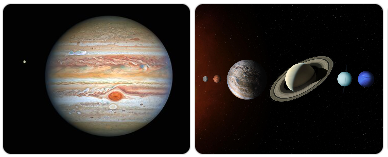
Planets are celestial bodies that orbit a star, have achieved an approximately spherical shape due to their own gravity, and have become gravitationally dominant in their orbital region. They do not produce light directly; instead, they are visible because they reflect the light of the star at their center. With these characteristics, planets are distinct from stars and smaller celestial objects. Within a star system, planets move along stable and regular orbits that can remain consistent over extremely long timescales.
For a celestial body to be defined as a planet, it must possess certain physical and dynamical properties. First, it must have sufficient mass for its own gravity to pull it into a nearly spherical shape. This indicates that planets have balanced internal structures rather than irregular, fragmented forms. Additionally, planets have either absorbed smaller objects in their orbit or cleared their orbital region of them. This characteristic demonstrates that planets are the dominant bodies in their respective orbital zones.
Planets show great structural diversity. Some have solid surfaces, while others consist mainly of dense gas and fluid layers. Rocky planets are dominated by silicates and metals, whereas massive planets are primarily composed of light gases such as hydrogen and helium. These differences are closely related to the conditions in which the planets formed and their distance from their central star. Heavier and solid materials tend to condense in regions closer to the star, while lighter gases can survive in colder, more distant regions.
The internal structures of planets are as diverse as their surfaces. Some planets have distinct core, mantle, and crust layers, while others exhibit more fluid and gradual transitions between layers. Inside large planets, extremely high pressures and temperatures prevail. Under such conditions, matter behaves very differently from what we experience on Earth. This makes planets scientifically important not only because of their surfaces but also because of their internal compositions.
Planets are also remarkable because of their motions. Each planet orbits its central star along a specific path and simultaneously rotates around its own axis. These two motions determine the day–night cycle and long-term seasonal changes of a planet. The shape and tilt of an orbit directly influence climatic and physical characteristics. Therefore, planetary motion is important not only in celestial mechanics but also in understanding long-term planetary evolution.
Planets are among the most prominent and long-lived members of star systems. The lifespan of a planet is often comparable to that of its central star. Over this immense span of time, planets may undergo changes in both their internal structures and environmental conditions. The formation, transformation, or loss of atmospheres, the reshaping of surfaces, and gravitational interactions with moons are all natural parts of planetary evolution.
Planets also continuously interact with smaller celestial bodies. Moons, rings, asteroids, and comets create complex dynamical systems around planets. These interactions provide valuable clues about a planet’s past. In particular, collisions and gravitational effects have played decisive roles in shaping planets into their present forms.
In conclusion, planets are fundamental celestial bodies that represent the order and diversity of star systems. Although they do not generate their own light, these worlds are shaped by the energy they receive from their stars and demonstrate how matter organizes and evolves under different cosmic conditions. Understanding planets means not only studying distant worlds but also comprehending the functioning of star systems and the fundamental principles of cosmic order.