A- and F-Type Stars

A- and F-type stars make up groups of stars that are hotter than the Sun within spectral classification, yet still more moderate than the hottest stellar types. Because these two spectral types are adjacent in temperature, they are often discussed together; however, there are clear physical and observational differences between them. A-type stars are hotter, more luminous, and generally appear in whiter to blue-white tones compared with F-type stars.
The surface temperatures of A-type stars are generally between about 7,500 and 10,000 degrees. This temperature range shifts a significant portion of their emitted light toward shorter wavelengths, which is why A-type stars are perceived as white or slightly bluish. To the naked eye, these stars often appear very bright and have a striking white brilliance in the night sky. Due to their luminosity, they are among the stars that can be easily picked out in the sky.
As an example of an A-type star, Vega—one of the brightest stars in the sky—belongs to this class. Vega’s bright white light reflects the typical visual characteristics of A-type stars. Similarly, Altair and Sirius are also often mentioned as stars with spectral properties close to the A-type range. Such stars are distinguished in the sky by their white light and are generally regarded as young and energetic stars.
F-type stars are slightly cooler than A-type stars. Their surface temperatures lie roughly between 6,000 and 7,500 degrees. This temperature difference also shows itself in the star’s color. F-type stars have a color that shifts from white toward yellow. In this sense, they form a transition group between A-type and G-type stars. Their light is neither as blue-white as A-type stars nor as yellow as G-type stars.
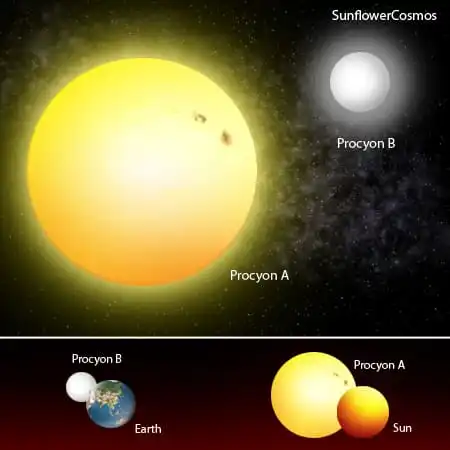
A well-known example of an F-type star is Procyon. Procyon displays the typical characteristics of F-type stars through its brightness and color. In addition, some F-type stars can be larger and more luminous than the Sun as they approach the boundary toward more evolved stages, while others are main-sequence stars with masses close to the Sun’s. This variety gives F-type stars an important place within stellar evolution.
The main differences between A- and F-type stars come down to temperature and, accordingly, color and the rate of energy production. Because A-type stars are hotter, nuclear reactions in their cores proceed more rapidly. This causes them to consume their energy more quickly. F-type stars, by contrast, produce energy in a more balanced way and can remain on the main sequence for a longer time. As a result, the lifetimes of F-type stars are generally longer than those of A-type stars.
Both spectral types are also interesting in terms of planetary systems. The intense radiation and shorter lifetimes of A-type stars can be limiting for the long-term evolution of planetary systems around them. F-type stars, with more moderate conditions and longer lifetimes, can provide more stable environments for the development of planetary systems. For this reason, F-type stars are often considered a more favorable focus than A-type stars when discussing environments closer to Sun-like (G-type) conditions.
From the perspective of stellar evolution, A- and F-type stars are generally classified within the low- to intermediate-mass star group. In later stages of their lives, when hydrogen in their cores is depleted, they expand and enter a giant phase. While the details vary depending on initial mass, the overall evolutionary route aligns with the typical path followed by low- and intermediate-mass stars.
In conclusion, A- and F-type stars occupy the mid-to-upper temperature region of the spectral system and are bright stars that are easy to notice in the sky. A-type stars stand out with their higher temperatures and shorter lifetimes, while F-type stars draw attention with more balanced energy production and longer lifespans. Considered together, these two spectral types provide an important comparison for understanding how stars follow different evolutionary paths depending on temperature and mass.