Explosions
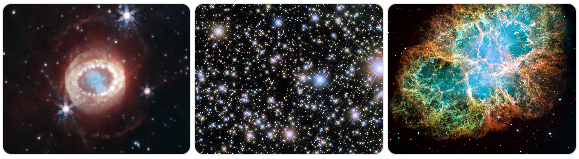
The universe hosts events far more violent and dramatic than we often imagine. Cosmic explosions are phenomena that arise from the death of a star or the release of extreme energy, and they can sometimes shine brighter than an entire galaxy.
SN 1987A, observed in 1987, is one of the closest supernovae visible to the naked eye in the modern era. This explosion in the Large Magellanic Cloud made it possible to study the final stages of stellar evolution directly. The ring-like structures seen after the blast revealed material ejections that occurred before the star’s death.
Gamma-ray bursts are among the most energetic events in the universe. Lasting only a few seconds, they can release—in seconds—the amount of energy the Sun would produce over its entire lifetime. These bursts are generally thought to occur when massive stars collapse or when neutron stars merge.
The Crab Nebula is the remnant of a supernova recorded by Chinese astronomers in 1054. That explosion was so bright it could be seen even in daylight, leaving behind a complex cloud of gas and a neutron star at its center. It is an important example where historical records and modern astrophysics meet.
These explosions do not only mark the end of stars; they also represent the creation of new elements. Many elements heavier than iron are produced during such explosions and then dispersed into space. In this way, explosions are productive events that increase the universe’s chemical richness.
In conclusion, cosmic explosions are among the most destructive yet also the most creative processes in the universe. The death of one star can lay the groundwork for the birth of other stars and planetary systems.