Long-Period Comets
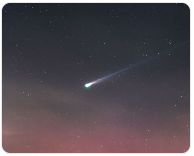
Long-period comets form the group with the longest orbital periods among the comets observed in the Solar System. Their journeys around the Sun can take thousands—or even hundreds of thousands—of years. For that reason, the approach of a long-period comet is often a rare event that may occur only once in the span of human history.
The orbits of these comets are extremely stretched and irregular. They are often tilted at large angles relative to the plane where most planets orbit. Some long-period comets even travel around the Sun in the opposite direction to the planets. This strongly indicates that their origins lie in the most distant regions of the Solar System.
The source of long-period comets is believed to be a faraway reservoir of icy bodies that surrounds the Solar System in a vast, roughly spherical distribution. Objects in this region remain extremely far from the Sun and at very low temperatures. These conditions allow long-period comets to survive for billions of years with little or no change.
From time to time, the orbit of one of these distant comets can be disturbed. The gravity of a passing star, tidal forces from the Milky Way, or indirect gravitational effects tied to the giant planets can redirect these objects toward the inner Solar System. After a long journey, the comet then approaches the Sun for the first time.
When long-period comets come close to the Sun, they can become exceptionally bright and dramatic. The main reason is that their nuclei can be large and rich in ices. Solar heating causes frozen material on the surface to rapidly turn into gas, producing very long and broad tails.
Comets such as Hale–Bopp and Hyakutake are among the best-known examples of this class. They became bright enough to be observed with the naked eye for weeks or even months. Such cases clearly show that long-period comets are rare, but can create extraordinarily memorable sky events.
A key trait of long-period comets is that they often show very high activity during their first close approach to the Sun. Surfaces that have never been warmed before can release gas and dust intensely when exposed to sunlight. After this first passage, however, some comets lose a substantial amount of material and may never reach the same level of brightness again.
The future of these comets is uncertain. Some are sent back onto extremely distant orbits after passing the Sun. Others are ejected entirely and become interstellar objects. Some pass so close to the Sun that they break apart or are destroyed.
Scientifically, long-period comets are extremely valuable. The materials they contain can preserve nearly unaltered information from the Solar System’s earliest stages. For this reason, they are considered unique natural samples for understanding the Solar System’s formation and early evolution.
In conclusion, long-period comets are among the Solar System’s most distant, most primitive, and most rarely observed members. With their immense orbits and impressive tails, they can create unforgettable sights in the sky. Studying these objects is one of the most direct ways to understand the Solar System’s boundaries and origins.