Reflection Nebula
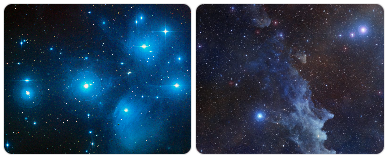
Reflection nebulae are types of nebulae that do not produce their own light, but become visible by reflecting the light coming from nearby stars. They form in regions of interstellar space that contain gas and, especially, large amounts of cosmic dust. Because they do not shine on their own, they can be observed only when they lie close to stars that are bright enough to illuminate them. With this characteristic, reflection nebulae are physically distinct from emission nebulae and other luminous nebular types.
The main mechanism that makes reflection nebulae visible is the scattering of starlight by dust grains. Rather than absorbing the incoming light, these dust particles largely disperse it into the surrounding space. During this process, shorter wavelengths are scattered more efficiently than longer wavelengths. For this reason, reflection nebulae are most often seen in blue and pale-blue tones. This coloration is a physical effect and provides important information about the nebula’s composition as well as the size distribution of its dust grains.
The gas within reflection nebulae is generally not as hot as the gas in emission nebulae. This is because the nearby stars do not emit radiation energetic enough to ionize the gas. As a result, the gas exists in a calmer environment. From this perspective, reflection nebulae are associated with later or more quiescent stages of star formation. The stars around them are typically not extremely hot newborn giants, but rather moderately hot stars that can illuminate dust without strongly ionizing the surrounding gas.
In terms of physical structure, reflection nebulae are quite complex. The dust they contain is the most important factor determining both their shape and their brightness. Dust density is not uniform across the nebula. Therefore, some areas appear brighter while others look dimmer or may remain completely dark. This uneven distribution gives reflection nebulae a soft, misty appearance with gentle transitions and wave-like textures.
Reflection nebulae are often observed together with star clusters. This is because the light of multiple stars can illuminate the same dust cloud, making the nebula appear spread across a wider region. The reflection nebulae surrounding the Pleiades cluster—known as the Seven Sisters in the constellation Taurus—are among the best-known examples of this situation. Similarly, the Witch Head Nebula in the constellation Orion displays a typical reflection-nebula structure that becomes visible by reflecting the light of a bright nearby star. Over time, stellar motions, stellar winds, and environmental effects reshape the nebula; reflection nebulae either disperse within millions of years or transform into other nebular types.
These nebulae are extremely important for understanding the physical properties of interstellar dust. The size, composition, and distribution of dust grains can be studied through the color and intensity of the reflected light. In this way, astronomers can investigate in detail how dust behaves within galaxies and how it interacts with starlight. Reflection nebulae, in this sense, are natural indicators that reveal otherwise invisible components of the cosmic environment.
The existence of reflection nebulae shows that gas and dust in galaxies are important not only for star birth, but also for understanding how light propagates through space. Starlight is scattered into different directions by these nebulae, indirectly illuminating the galactic environment. This interaction can also influence the overall brightness and appearance of galaxies on large scales.
In conclusion, reflection nebulae reveal the direct interaction between light and matter in the universe. Even though they do not generate their own light, they become distinct within the darkness of space by reflecting starlight. These nebulae are essential for understanding the nature of interstellar dust and for unraveling the physical conditions of the galactic environment.