Supernova Remnants
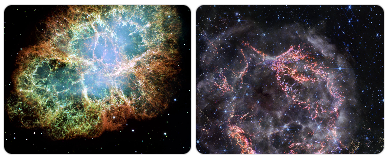
Supernova remnants are structures formed from the material thrown into space after a massive star ends its life in an extremely violent explosion. These remnants carry the traces of one of the most energetic events in the universe and represent the most dramatic phase of stellar evolution. During a supernova explosion, the star’s inner layers are blasted outward at tremendous speed, while the released gas and energy profoundly affect the surrounding interstellar environment.
A supernova explosion occurs as a result of a sudden and irreversible collapse in the star’s core. After a massive star exhausts its nuclear fuel, it can no longer resist its own gravity. While the core collapses in a very short time, the outer layers respond to this collapse by being hurled violently into space. This process can make the star’s brightness, for a brief period, approach that of an entire galaxy.
After the explosion, the gas ejected into space continues to expand outward at speeds reaching thousands of kilometers per second. This expanding shell of gas forms the supernova remnant. Over time, the structure interacts with the interstellar medium and takes on complex, irregular shapes. The Crab Nebula is one of the best-known examples of such an expanding supernova remnant, and traces of energetic processes left behind by the explosion can still be observed within it. Shock waves compress surrounding gas and can trigger the onset of new physical processes.
The internal structure of supernova remnants is extremely dynamic. The expanding gas interacts with magnetic fields and contributes to the formation of high-energy particles. Processes occurring in this environment are considered a major source of a significant portion of cosmic rays. The remnant Cassiopeia A is another important example in which this dynamic internal structure can be observed clearly, with its irregular form and intensely energetic regions. The presence of both very hot and relatively cooler zones within the same remnant reveals the complex nature of supernova remnants.
One of the most important roles of supernova remnants is their contribution to chemical enrichment in the universe. Heavy elements formed in the cores of massive stars are scattered into space during the supernova explosion. Iron, gold, and many even heavier elements mix into the interstellar medium through this process. This material is later used in the formation of new stars and planetary systems. From this perspective, supernova remnants play a fundamental role in diversifying matter across the cosmos.
Supernova remnants can also act as triggers for star formation. Expanding shock waves compress nearby gas clouds, creating conditions that can lead to the birth of new stars. This shows a direct connection between the death of one star and the birth of others. This long-term cosmic cycle shapes the structure and evolution of galaxies.
As time passes, supernova remnants continue to expand and gradually merge with the surrounding environment. After millions of years, the remnant’s gas becomes fully dispersed and its original structure disappears. However, the chemical and physical effects it leaves behind create lasting traces within the galaxy. For this reason, even though supernova remnants are visually short-lived structures, they can produce long-term consequences for cosmic evolution.
In conclusion, supernova remnants represent one of the most destructive yet most productive stages of the stellar life cycle. These structures, created during a star’s death, deliver energy, heavy elements, and star-forming conditions to the universe. They are among the strongest examples showing that the universe is not static, but continuously transforming.