Intermediate-Mass Black Holes
Intermediate-mass black holes are the “in-between” class that lies between stellar-mass black holes and supermassive black holes. Their masses can range from about one hundred solar masses up to hundreds of thousands of solar masses. This mass range places them in an important bridging position in black hole evolution.
For many years, the existence of intermediate-mass black holes was predicted mainly in theory, while observational evidence remained limited. One reason is that these black holes may be more likely to reside in dense star clusters rather than in galaxy centers. Making direct observations in such environments is extremely difficult.
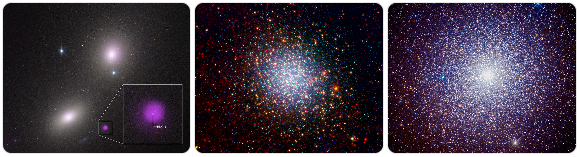
HLX-1 is one of the strongest known candidates for an intermediate-mass black hole. This source is located near the galaxy ESO 243-49 and was detected through its powerful X-ray emission. Its mass is thought to be on the order of tens of thousands of solar masses. HLX-1 is considered one of the most compelling observational pieces of evidence for intermediate-mass black holes.
Omega Centauri is the largest globular star cluster in the Milky Way, and there are strong indications that an intermediate-mass black hole may exist at its center. The velocity distribution of stars near the core suggests the presence of a concentrated unseen mass.
47 Tucanae is another globular cluster believed to contain an unseen central concentration of mass. Precise measurements in clusters like these support the idea that intermediate-mass black holes may truly exist in the universe.
How intermediate-mass black holes form is still under investigation. One possible scenario is the merging of many stellar-mass black holes in dense star clusters. Another possibility is formation through the direct collapse of massive gas clouds in the early universe. These black holes may represent an early evolutionary stage of supermassive black holes.
In conclusion, intermediate-mass black holes are often described as the “missing link” in black hole classification. Their existence is crucial for understanding how the transition from stellar-mass black holes to supermassive black holes occurs. For this reason, they remain one of the most active research topics in modern astrophysics.