How Do Nebulae Form?
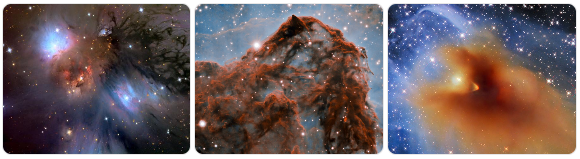
The formation of nebulae is not a random process in the universe; it is the outcome of fundamental physical laws—such as gravity, gas dynamics, and stellar evolution—working together over immense timescales. Galaxies are not completely empty. Between stars there exists an environment made of gas and dust, even if it is extremely tenuous. Over time, this interstellar material begins to accumulate in certain regions due to the galaxy’s rotation, the influence of spiral arms, and large energetic events that occurred in the past. This gradual concentration is the first step in the birth of a nebula.
Especially within the spiral arms of galaxies, gas and dust are found in a more compressed state. This happens because spiral arms behave like density waves—regions where matter piles up as it passes through. Gas moving through these zones is squeezed for a short time, and its density increases. As density rises, the material’s own gravity becomes more effective. Instead of dispersing, the interstellar gas can remain together and form large-scale clouds. Over time, these clouds develop into structures we identify as nebulae.
Another major factor in nebula formation is the violent end stages of massive stars. Very high-mass stars eject enormous amounts of energy and material into space when they explode as supernovae. These explosions enrich the surrounding interstellar gas while also compressing it through powerful shock waves. In the regions where a shock wave passes, gas density can rise rapidly, and this compression can trigger the emergence of new nebulae. For this reason, many nebulae can be considered indirect products of ancient supernova events.
Temperature plays a critical role in the nebula formation process. Interstellar gas cannot condense unless it can cool sufficiently. Cooling allows atoms and molecules to lose energy and move closer together. In particular, cold regions that contain molecular hydrogen become more stable, allowing gas clouds to persist and grow. These cold, dense areas can expand over time into giant molecular clouds. Such structures form the primary environments not only for nebula development but also for the birth of stars.
After a nebula forms, it does not remain static. The gas and dust within it are constantly in motion under the influence of gravity. In some locations, density increases more than in others. These denser cores can begin to collapse. As collapse proceeds, temperature rises and the birth of new stars begins. In this way, a nebula is not merely a completed structure; it becomes an active environment that can produce new celestial objects from within itself.
Not all nebulae form in the same way. Some arise through the slow and calm concentration of interstellar gas, while others appear after extremely violent events. Sun-like stars can create nebulae by shedding their outer layers near the end of their lives, leaving expanding shells of gas behind. More massive stars, on the other hand, explode and leave nebular remnants spread across far larger volumes of space. These different formation pathways explain why nebulae display such a wide variety of shapes and appearances.
Nebula formation is also directly linked to the chemical evolution of the universe. Heavy elements expelled by stars mix into newly forming nebulae. As a result, every new nebula carries the chemical inheritance of previous generations of stars. This ongoing process allows increasingly complex atoms and molecules to emerge in the cosmos. The origin of planets—and the materials necessary for life—belongs to this same chain of enrichment and recycling.
In conclusion, nebulae are clear evidence that matter in the universe is not static but constantly transforming. The slow gathering of interstellar gas, the explosions of massive stars, and the steady operation of physical laws over long timescales combine to create these vast structures. Every nebula holds traces of events from the universe’s past and also serves as a starting point for the stars and planets that will form in the future.