What Are Stars?
Stars are the fundamental celestial bodies in the universe that can produce their own energy. Thanks to nuclear reactions occurring in their cores, they emit light and heat. This is what distinguishes them from planets and other objects. Stars are the primary source of energy production in the cosmos, and the physical structure of galaxies is largely determined by how stars are distributed and what properties they have.
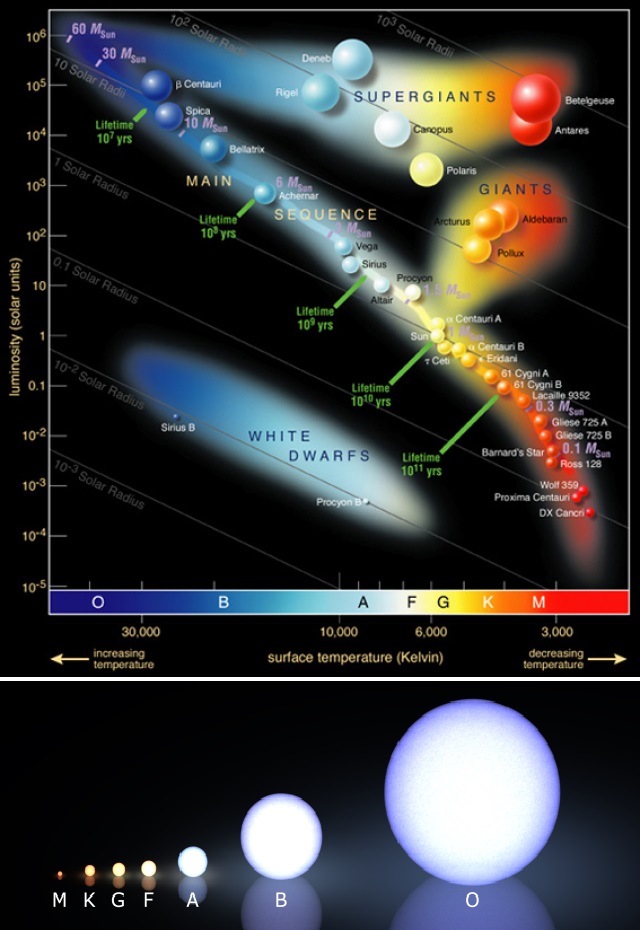
Although stars may look like similar bright points from the outside, in reality they possess very different physical characteristics. To understand these differences and study them within an organized framework, stars are classified. The most basic and most widely used method of classification is based on analyzing the light a star emits. This approach is called spectral classification.
The light emitted by a star is not merely a matter of brightness. When examined in detail, it can be separated into different wavelengths. Breaking down starlight in this way provides direct information about the star’s surface conditions. Spectral classification is performed by looking at the overall distribution of the star’s emitted light—meaning the basis of the system is how much energy the star radiates at different wavelengths.
The primary criterion for grouping stars within the spectral system is surface temperature. As a star’s surface temperature increases, the dominant wavelength of its emitted light changes. This causes stars to appear in different colors. The spectral system places stars into an ordered sequence according to these temperature differences. In this way, stars are grouped not randomly, but according to a physical measurement.
Spectral classification is not merely a naming scheme. Thanks to this system, comparisons can be made among stars in the sky. Stars belonging to the same spectral class are understood to share similar physical conditions. This gives astronomers the ability to infer general stellar behavior without having to study every star individually. In this sense, the spectral system is one of the foundations of stellar science.
The Sun is also a star within this spectral system. It belongs to the group of moderately hot stars, which is why it is neither among the extremely hot nor the extremely cool stars. The Sun’s position demonstrates that the spectral system is not only valid for distant stars, but also consistent and meaningful for the star closest to us.
Classifying stars based on their spectra also provides indirect information about their lifetimes, evolutionary paths, and distributions within galaxies. Stars in the same spectral class tend to have similar lifespans and comparable evolutionary processes. For this reason, the spectral system is not only a classification tool but also one of the keys to understanding stellar evolution.
The billions of stars visible in the sky can be studied in an organized and understandable structure thanks to this system. Without spectral classification, stars would be perceived only as bright points. With this system, each star is placed into a specific position according to its physical properties, turning the overall stellar population of the universe into a coherent whole.
In conclusion, stars are not merely objects that emit light; they are structures that can be classified according to their physical properties and therefore understood. The spectral system organizes the sky scientifically by grouping stars based on surface temperature. The Sun is part of this order. Getting to know stars begins with understanding the logic of this classification.