Magnetars
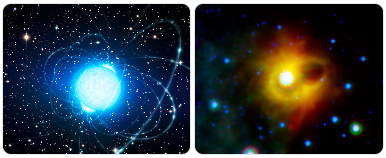
Magnetars are among the most extreme and unusual subtypes of neutron stars. They possess the strongest magnetic fields known in nature. A magnetar’s magnetic field can be hundreds of times stronger than that of a typical neutron star. These extraordinary fields place magnetars among the most extreme objects in the universe not only in terms of density, but also in terms of their physical effects.
A magnetar’s magnetic field is trillions of times stronger than Earth’s. Near the star’s surface, the field can become strong enough to affect the internal structure of atoms. Magnetar magnetic fields are so intense that they strongly shape the surrounding spacetime and electromagnetic environment. This is the key feature that distinguishes magnetars from ordinary neutron stars.
The emergence of a magnetar is closely tied to the conditions present at the moment a neutron star forms. If the collapsing core is rotating extremely rapidly and already has a very strong magnetic field, that field can be compressed and amplified to extraordinary strength during collapse. The result is a neutron star whose behavior is dominated by magnetic energy—what we call a magnetar.
Magnetar surfaces are highly unstable. Extreme magnetic stresses can crack and fracture the star’s solid crust, releasing enormous amounts of energy. During such events, intense bursts of X-rays and gamma rays are emitted into space. Although brief, these outbursts can approach the energy output of all the stars in a galaxy combined.
One of the best-known magnetars is SGR 1806-20, which drew attention due to an exceptionally powerful gamma-ray flare observed in 2004. Even though the event occurred tens of thousands of light-years away, it produced measurable effects in Earth’s ionosphere. Events like this show just how energetic and influential magnetars can be.
Another important example is SGR 1900+14, which has also produced powerful energy bursts and strongly affected its surrounding space. Such examples show why magnetars are often associated with sources known as “soft gamma repeaters,” which are characterized by irregular yet extremely energetic bursts.
Magnetars are highly important in astrophysics. They allow researchers to investigate how matter and magnetic fields behave under extreme conditions. The radiation magnetars emit can provide indirect information about neutron-star interiors and crust properties. For this reason, magnetars are not only rare and intriguing objects, but also unique natural laboratories for fundamental physics.
A magnetar’s lifetime depends on how quickly it loses its magnetic energy. As the magnetic field gradually weakens, magnetar activity fades and the star can become more like an ordinary neutron star. Yet throughout this transition, magnetars can continue producing some of the most energetic events in the universe.
In conclusion, magnetars represent one of the most extreme endpoints of neutron stars. With extraordinarily strong magnetic fields, sudden energy eruptions, and deep effects on their surroundings, they are rare but spectacular cosmic objects. Understanding magnetars means understanding the limits of magnetism and ultra-dense matter in the universe.