Jupiter-Family Comets
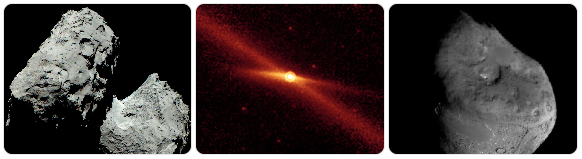
Jupiter-family comets are a group that makes up a large fraction of the comets observed in the Solar System and is characterized by relatively short orbital periods. Their orbits are strongly influenced by the powerful gravity of Jupiter, the Solar System’s largest planet. For this reason, the group is defined largely by Jupiter’s dynamical control.
The orbital periods of these comets are typically under about twenty years. Such short periods mean they approach the Sun frequently and can be observed regularly in the inner Solar System. Their orbits also tend to lie close to the plane where the planets orbit. This indicates that Jupiter-family comets are especially exposed to gravitational interactions with planets.
One of the best-known members of this family is comet 67P/Churyumov–Gerasimenko. It is notable for its irregular, “two-lobed” nucleus. As it approaches the Sun, strong jets of gas and dust erupt from its surface. This behavior clearly shows that Jupiter-family comets are active objects that continuously lose material.
Another important example is comet 2P/Encke. Encke has one of the shortest known orbital periods and completes a trip around the Sun in only a few years. Because it approaches the Sun so often, its nucleus has been significantly worn down over time. Even so, its ability to form a coma and tail demonstrates the persistence of Jupiter-family comets.
Comet 9P/Tempel 1 is also a notable member of this family. It is known for a relatively rounded nucleus and active regions on its surface. With each close pass to the Sun, new material is released from its surface. This shows that Jupiter-family comets are not static bodies, but objects that evolve and change over time.
Because they repeatedly come close to the Sun, Jupiter-family comets gradually lose large amounts of ice. With every close passage, another layer from the nucleus surface is shed into space. Over time, this causes the comet to shrink and its activity to weaken. Some members may eventually lose much of their ability to form a visible tail.
Jupiter’s role in this process is twofold. The giant planet can steer these comets into the inner Solar System, making them observable. At the same time, it can also eject some comets entirely from the Solar System or destabilize their orbits. In that sense, Jupiter acts as both a transporter and a filter.
Scientifically, Jupiter-family comets are very valuable. Because they can be observed relatively often, researchers can study their physical structure, surface activity, and long-term evolution in detail. These comets provide unique examples for understanding how primitive Solar System material changes over time.
In conclusion, Jupiter-family comets are dynamic objects shaped under Jupiter’s strong gravitational influence, with short orbital periods that bring them regularly into the inner Solar System. Thanks to the primitive material they carry and the changes they undergo over time, they play a fundamental role in understanding the Solar System’s evolution.