Pulsars
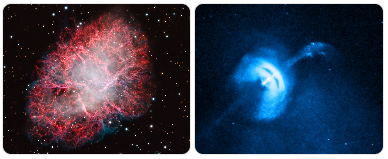
Pulsars are among the best-known and most easily observed subtypes of neutron stars. They are rapidly rotating neutron stars that, due to their powerful magnetic fields, emit electromagnetic signals at regular intervals. From Earth, these signals are detected as steady, rhythmic pulses—much like the sweeping beam of a lighthouse. These regular pulses are the defining observational feature that gives pulsars their name.
The formation of a pulsar is directly tied to a neutron star’s rapid spin and strong magnetic field. During its birth, a neutron star inherits enormous angular momentum and can begin rotating at extraordinary speeds. At the same time, its magnetic field is compressed and greatly strengthened during collapse. If the magnetic axis does not align with the rotation axis, radiation emitted from the magnetic poles sweeps through space in a cone-shaped beam.
Pulsar emission is most commonly detected in radio waves, but some pulsars also emit X-rays and gamma rays. As the star rotates, its beams sweep across space, and each time Earth lies in the path of the beam, a pulse is observed. For this reason, pulsars behave like extremely precise “cosmic clocks.” Some are so stable that their rotation periods can be measured with a precision comparable to atomic clocks.
Pulsar spin rates vary widely. Some rotate only a few times per second, while others can spin hundreds of times per second. A special group known as millisecond pulsars stands out for its extraordinary speed. These objects are thought to have been “spun up” in the past through the transfer of matter from a companion star, which increases their rotation rate again and can keep them spinning rapidly for very long periods.
One of the most famous pulsars is the Crab Pulsar, located at the center of the Crab Nebula. It is the remnant of a historically observed supernova explosion and produces powerful radiation while spinning dozens of times per second. Another important example is the Vela Pulsar, which is close enough and bright enough to be studied in great detail. Such examples clearly show the direct connection between pulsars and supernova remnants.
Pulsars are not only fascinating objects; they are also key tools in modern astrophysics. Their regular signals can be used to test the structure of spacetime, investigate indirect effects of gravitational waves, and probe the magnetic structure of the galaxy. Even tiny irregularities in pulsar timing can provide clues about large-scale events occurring across the universe.
Over time, pulsars lose energy and their rotation slows. This spin-down causes the emitted radiation to weaken. Beyond a certain point, a pulsar may no longer produce observable pulses. However, this does not mean the star has vanished—only that its pulsar phase has ended.
In conclusion, pulsars are one of the most striking and instructive manifestations of neutron stars. Born from the combination of extreme density, rapid rotation, and powerful magnetic fields, they show that the universe can contain both order and extreme physical conditions at the same time. Studying pulsars plays an essential role in understanding both the final stages of stellar evolution and the fundamental laws of physics.