What Are Black Holes?
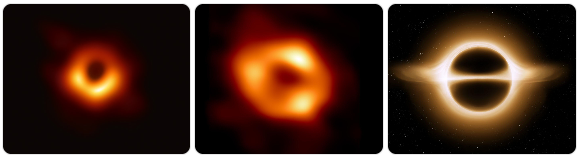
Black holes are celestial objects whose gravity is so strong that, within a certain boundary, nothing—not even light—can escape. This property makes them some of the most extreme physical objects in the universe. Black holes cannot be seen directly because they do not emit light. However, their existence can be inferred from their effects on surrounding matter.
A black hole’s defining feature is the boundary called the “event horizon.” The event horizon is the region where the escape velocity equals the speed of light. Any matter or light that crosses this boundary cannot return. The size of the event horizon depends on the black hole’s mass: as mass increases, the event horizon grows.
At the center of a black hole lies what is called a “singularity,” a region where the laws of classical physics are thought to break down. The singularity is a hypothetical point where matter is assumed to reach infinite density. Modern physics cannot fully describe the singularity; understanding it requires combining general relativity with quantum mechanics.
Black holes are not merely passive objects that pull matter inward. Gas and dust falling toward a black hole heat up and emit high-energy radiation. The accretion disk formed in this process can make the black hole’s presence visible indirectly. In some cases, enormous energy jets can be launched into space from the black hole’s poles.
For a long time, black holes were considered purely theoretical. However, in 2019 the direct image of the black hole at the center of the Messier 87 galaxy, and later the image of the black hole at the center of the Milky Way, showed that black holes are also confirmed observationally.
Black holes are not all the same. They are classified into different groups by mass, including stellar-mass black holes, supermassive black holes, intermediate-mass black holes, and primordial black holes. This diversity is also important for understanding how they form and evolve.
In conclusion, black holes are the densest objects in the universe with the strongest gravitational fields. Although they cannot be seen directly, they can be studied through their effects on their surroundings, making them one of the most important research areas in modern astrophysics.