How Do Constellations Form?
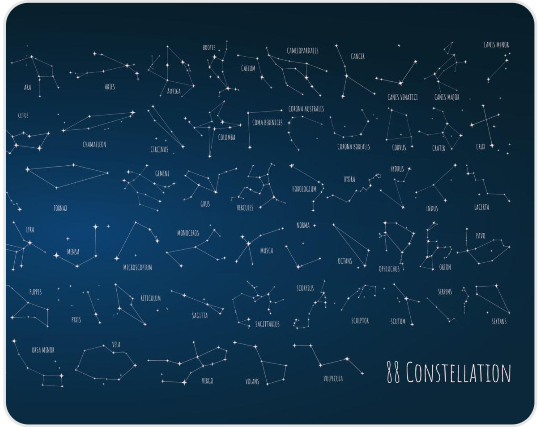
The formation of constellations is related less to a physical process in the universe and more to human perception and interpretation. Stars exist at very different distances and directions within the three-dimensional structure of space. Yet from Earth, they appear as if they were fixed points on the same celestial sphere. The human eye and mind tend to look for orderly shapes within this two-dimensional appearance. The emergence of constellations is a result of this need to organize what we see.
The stars visible in the sky are, in reality, distributed in space without forming such patterns. The distances between them are often unimaginably large. However, because stars are so far away, this depth difference cannot be perceived with the naked eye. The human eye uses brightness and apparent position to perceive stars as if they were on the same plane. This makes it possible to draw imaginary lines between stars and form shapes.
The earliest constellations appeared as humans began observing the sky regularly. Star patterns that repeated each year were noticed and gradually became familiar. People compared these recurring shapes to animals, objects, or mythological figures and named them accordingly. These comparisons made the sky easier to remember and to pass on. In this way, constellations became a system of knowledge transmitted from generation to generation.
Culture has a major influence on how constellations formed. The same group of stars was interpreted in completely different ways in different regions and societies. A pattern seen as a hunter by one community might be seen as a god, an animal, or a tool by another. This shows that constellations are not universal physical structures, but sky maps shaped by cultural perspectives.
Over time, as sky knowledge became more systematic, the boundaries of constellations were defined more clearly. In modern astronomy, constellations are treated not only as star shapes but also as designated areas of the sky. These areas divide the sky into sections and make it easier to describe the positions of stars and other celestial objects. In this way, constellations became a practical tool for scientific observation as well.
Another important factor in the formation of constellations is Earth’s motions. Earth’s rotation on its axis and its orbit around the Sun cause the stars to appear in different positions over time. Even so, certain star groups return in similar shapes during the same seasons each year. This regularity helped constellations be identified and remain stable as recognized patterns.
In this sense, constellations are not structures that truly “form” in the universe; they are products of humanity’s effort to understand and organize the cosmos. Even if the physical properties of stars do not change, people mentally group them together in order to interpret the sky. This clearly shows how science and human perception can intersect in our view of the heavens.
In conclusion, constellations arise not from the real spatial arrangement of stars, but from the visual relationships that appear when viewed from Earth. The human mind transformed the complexity of the sky into recognizable shapes to simplify and interpret it. For this reason, constellations are unique structures that reflect both the physical reality of the sky and humanity’s way of perceiving the universe.