Comets by Their Orbits
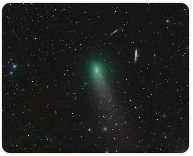
Comets are distinguished from one another less by their physical structure than by the orbits they follow. The path a comet takes around the Sun is the key factor that determines its origin, how often it can be observed, and how it is likely to change over time. For this reason, comets are commonly studied by classifying them according to their orbits.
Some comets return to the Sun at regular intervals. These objects have relatively short orbits with a clear period, and their paths are often close to the plane in which the planets orbit. This indicates that such comets move in a way that is broadly consistent with the overall structure of the Solar System. Because they come back repeatedly, they can be observed more than once within a human lifetime.
Another group of comets approaches the Sun far more rarely. Their orbits are extremely long and highly elliptical. The time between visits can be hundreds or even thousands of years. Such trajectories suggest that these comets come from very distant regions of the Solar System. In many cases, they are observed only once.
Comet orbits differ not only in length but also in inclination. Some comets travel on paths that remain close to the planetary orbital plane, while others follow orbits tilted at large angles relative to it. Some even orbit the Sun in the opposite direction to the planets. This diversity indicates that comets may originate from multiple reservoirs rather than a single source region.
The gravity of the giant planets plays a decisive role in shaping comet orbits. In particular, massive planets like Jupiter can alter a comet’s trajectory. Through close encounters with planets, a comet’s orbit can become shorter, longer, or be redirected into a very different path altogether. These gravitational interactions often determine a comet’s long-term fate.
Some comets can eventually be ejected from the Solar System entirely. Others pass so close to the Sun that they fragment or vaporize and disappear. In rare cases, some comets may be shifted onto paths that pose an impact risk with planets. This shows that comets are not only visually impressive objects, but also dynamic bodies that can have real effects.
Orbit-based classification is a fundamental tool for understanding comet origins. Short-period comets have typically approached the Sun many times before, meaning their surfaces may have changed significantly. Long-period comets, by contrast, may preserve more of the Solar System’s most primitive material.
Comet orbits also shape their observational behavior. Comets that return frequently tend to be more predictable, while those with extremely long orbits can appear unexpectedly. For this reason, each new comet discovery provides fresh insight into the Solar System’s dynamic nature.
In conclusion, comets are divided into different groups based on the orbits they follow, and those orbital paths determine both their past and their future. Orbital characteristics are the key to understanding where comets come from, how long they remain active, and what role they play within the Solar System. Evaluating comets together with their orbits makes it possible to grasp the full cosmic story of these ancient bodies.