Dwarf Planets
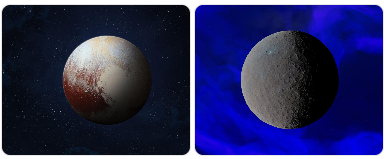
Dwarf planets are celestial bodies that orbit a star and have achieved a spherical or nearly spherical shape due to their own gravity. In this respect they resemble planets; however, the key difference that separates them from planets is that they are not the single dominant body in their orbital region. Dwarf planets share their orbital paths with other objects and have not fully cleared their neighborhood.
The concept of dwarf planets emerged as the Solar System began to be studied in greater detail. Especially in the outer regions of the system, the discovery of many objects smaller than planets but larger than asteroids made it necessary to define an intermediate category. These bodies are neither dominant enough to be considered classical planets, nor are they small and irregular like many minor objects. For this reason, dwarf planets hold an important place in understanding the structural diversity of the Solar System.
One of the best-known dwarf planets is Pluto. For many years it was accepted as a planet, but it orbits in a very distant region from the Sun and experiences extremely cold conditions. Pluto’s orbit is more tilted and more elliptical than those of the planets. This demonstrates how different and complex the orbits of dwarf planets can be. The fact that Pluto has multiple moons also shows that these bodies can possess their own small systems.
Another important dwarf planet in the Solar System is Ceres. Ceres is located in the asteroid belt between the inner and outer planets, which sets it apart from most other dwarf planets. It is the largest object in its region, and its spherical shape is the reason it is classified as a dwarf planet. This shows that dwarf planets are not found only in the distant outer Solar System, but can also exist in more inner regions.
Dwarf planets also display diversity in their physical structures. Some are composed largely of rock and ice, while others may have more complex interiors. Their surfaces can contain craters, fractures, and frozen materials. These features suggest that dwarf planets are ancient structures preserved from the early Solar System and have reached the present day with relatively limited change.
These objects can be considered incomplete outcomes of the planet formation process. Bodies that failed to gain enough mass, or that formed in regions crowded with competing objects, could not become full planets and remained as dwarf planets. For this reason, dwarf planets are extremely valuable for understanding how planets form and under what conditions they develop.
Dwarf planets also play an important role in understanding the boundaries and structure of the Solar System. Especially those located in distant regions reveal how widely the Solar System extends and what types of objects exist there. Studying these bodies contributes to developing models of how the Solar System formed and evolved.
In conclusion, dwarf planets are unique worlds positioned between planets and smaller minor bodies. Neither fully planets nor ordinary small objects, they reveal the diversity and complexity of the Solar System. Studying dwarf planets is crucial for understanding the limits of the planet concept and for uncovering the early evolution of the Solar System.