What Are Nebulae?
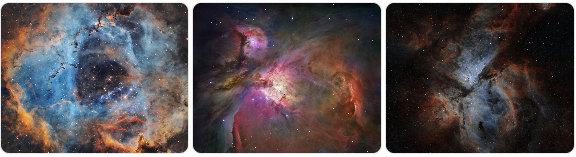
Nebulae are enormous structures composed of gas and cosmic dust that fill the interstellar space within galaxies. A significant portion of the visible matter in the universe exists within these formations, which is why nebulae are considered one of the fundamental components of cosmic structure. At first glance, they may appear like misty clouds suspended in the sky, yet physically they are entirely different from atmospheric clouds on Earth. Nebulae consist of extremely diffuse matter; there are vast spaces between their atoms and molecules. Despite this, the regions they occupy in space are so immense that their total mass can reach millions of times that of the Sun.
A nebula may span just a few light-years across, or extend for tens, hundreds, and in some cases even thousands of light-years. Structures of this scale are among the largest and most striking natural formations in the universe. Compared to any vacuum or empty space experienced in daily life, nebular matter would appear almost like absolute emptiness. Yet over long cosmic timescales, this sparse material responds to gravity and provides the environment necessary for star formation.
The chemical composition of nebulae directly reflects the overall structure of the universe. Most of their matter consists of hydrogen and helium, the first and most abundant elements formed after the Big Bang. In much smaller amounts, heavier elements such as carbon, oxygen, nitrogen, neon, and iron are also present. These heavier elements did not exist in the early universe; they were created inside the cores of earlier generations of stars through nuclear reactions and later dispersed into space when those stars ended their lives. For this reason, every nebula also serves as a chemical record of the universe’s past.
Nebulae are not physically uniform structures. Within a single nebula, large variations in temperature, density, and chemical composition can be observed. Some regions are extremely cold and dense; in these areas hydrogen atoms exist in molecular form, creating suitable conditions for the birth of new stars. Other regions are heated and ionized by the high-energy radiation emitted from young, hot stars. This diversity gives nebulae their complex and layered structure.
The different colors observed in nebulae are a direct result of these physical conditions. Some nebulae glow in reddish tones, while others display blue or greenish hues. Certain regions may appear completely dark. These colors are not aesthetic enhancements or artistic effects; each is directly related to the gas composition, temperature, and the energy emitted by nearby stars. For this reason, photographs of nebulae are not only visually impressive but also scientifically valuable.
Nebulae are not passive structures in the universe; on the contrary, they represent some of the most active stages of cosmic evolution. New stars, planetary systems, and indirectly the chemical elements necessary for life emerge within these regions. The life cycle of a star often begins inside a nebula and ends by returning material back into a nebular environment. This demonstrates the existence of a continuous cycle of matter in the universe. Material expelled from stars mixes into new nebulae, new stars form from those nebulae, and the process repeats over millions of years.
In this context, nebulae shape both the past and the future of galaxies. Their concentration along the spiral arms of galaxies is no coincidence; these regions are where star formation is most active. For example, the Orion Nebula is still producing new stars today and is one of the most thoroughly studied nebulae in the universe. Through such structures, astronomers can understand how stars are born, how they evolve under different conditions, and how galaxies change over time.
In conclusion, nebulae are the starting points and transformation hubs of matter in the universe. These cosmic environments—where stars are born, live, and die—are fundamental structures that guide the physical and chemical evolution of the cosmos. A large portion of the atoms that make up Earth, the Sun, and everything around us once existed within a nebula. Therefore, understanding nebulae means understanding not only distant celestial objects, but also our own origins.