Halley-Type Comets
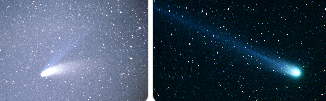
Halley-type comets form a distinct group among the comets observed in the Solar System, defined mainly by their orbital characteristics. They are neither as short-period as Jupiter-family comets nor as rare and extremely elongated in their paths as the longest-period comets. Instead, Halley-type comets occupy the middle ground: they can return to the Sun at intervals that are long, yet still periodic.
The most defining feature of this class is that these comets have long but repeating orbits. Their orbital periods are typically longer than twenty years but generally limited to a few hundred years. Because of this, Halley-type comets may have been recorded multiple times throughout human history. The fact that the same comet can reappear in the sky after centuries is a key criterion in identifying this group.
The orbits of Halley-type comets are highly elliptical. When they pass close to the Sun, they can become very bright, while they spend most of their time in the colder outer regions of the Solar System. During these long journeys, their nuclei can remain relatively unchanged. This helps Halley-type comets preserve their primitive structure for extended periods.
The most famous member of this group is Halley’s Comet. With an orbital period of about seventy-six years, Halley has been documented by many civilizations across history. Recognizing that the same object returns on a schedule was crucial for understanding that comets are not random events, but Solar System bodies moving on predictable paths. For this reason, Halley’s Comet holds a special place in the study of comets.
Another well-known example often discussed in this context is Comet Hale–Bopp. Although Hale–Bopp has a very long orbital period, it appeared extraordinarily bright during its passage near the Sun. That brightness is linked to its large nucleus and strong activity. Observations of Hale–Bopp showed that Halley-type comets can vary widely in size and brightness.
The origin of Halley-type comets is associated with the outer regions of the Solar System. It is thought that some of these objects formed far from the Sun and later settled into their current orbits through gravitational interactions. Giant planets such as Jupiter and Saturn likely played an indirect role in shaping and stabilizing these cometary paths.
Compared with Jupiter-family comets, Halley-type comets approach the Sun less frequently. As a result, their surfaces tend to erode more slowly. They still lose material during each passage, but typically not as rapidly as many Jupiter-family comets. This allows Halley-type comets to remain active over much longer timescales.
Scientifically, Halley-type comets are especially valuable. Their ability to preserve primitive material while also being observable more than once makes them strong targets for long-term study. By observing them across repeated returns, scientists can compare early Solar System material with how it changes over time.
In conclusion, Halley-type comets hold a unique position among comet groups because of their long yet periodic orbits. Their repeated returns connect historical records with modern astronomy, creating a direct bridge between past observations and present-day science. For both scientific and cultural reasons, Halley-type comets remain central to our understanding of comets and the Solar System’s history.