Historical Events
Throughout history, the sky has hosted major transits and rare alignments that people could follow directly with their own eyes. Some of these events are so clear and striking that they appear not only in astronomical records, but also in photo archives and eyewitness accounts. Their impact often comes not from a violent change like an “explosion,” but from the slow, certain motion of the sky’s immense scale.
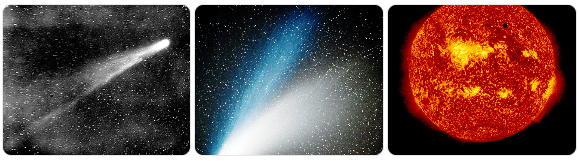
Halley’s Comet’s close pass by Earth in 1910 is considered one of the most famous sky events of the modern era. Halley became bright enough to be seen with the naked eye, forming a distinctive nighttime view with its tail. This passage received wide attention in newspapers and popular stories of the time, and advances in photography also made it possible to document Halley’s appearance. Such observations showed that comets are not merely “a passing light,” but physical objects that change as they approach the Sun.
The Hale–Bopp Comet seen in 1997 provided one of the most impressive comet displays in recent history. Its long visibility and high brightness turned it into a globally watched “visitor in the sky.” The fact that it could be noticed in many places even with city lights made it one of the rare events that also left a strong mark on popular culture. Hale–Bopp is a period turning point in which comets were recorded not only in historical texts, but also in detailed modern photographs.
Another notable type of historical sky event is planetary transits. The transit of Venus in 2012 was a rare alignment in which Venus moved across the face of the Sun like a small black dot. This event is not only an aesthetic view; historically it played a key role in understanding the scale of the Solar System. Venus transits occur in pairs with very long gaps between them, so it is often impossible to witness another within a single human lifetime. This rarity makes it one of the purest and most striking examples of the idea of “something crossing the sky.”
What these events share is that the motion in the sky can be followed with a clarity that speaks directly to human perception. A comet accompanying the nights for weeks, or a planet silently crossing the Sun, makes the dynamic nature of the universe visible in its simplest form.
In conclusion, some historical sky events can be astonishing without being disasters or explosions. The “history” of the sky is not only the sum of violent events, but also of rare alignments and once-in-a-lifetime transits.