M-Type Stars
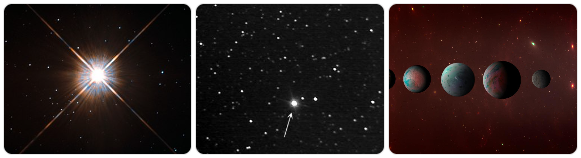
M-type stars are the most numerous class of stars in the universe. About three quarters of the stars in the Milky Way Galaxy belong to this category. These stars are generally low in mass, low in temperature, and low in luminosity. The reason they are rarely visible to the naked eye is that the light they emit is quite faint. Nevertheless, the true stellar population of the universe is largely made up of M-type stars.
The surface temperatures of M-type stars are lower than those of other stellar types. These temperatures range roughly between 2,400 and 3,700 degrees. For this reason, their light appears in tones close to red, and these stars are also called red dwarfs. Their color is directly linked to surface temperature and is an important measure in spectral classification.
The star closest to the Sun, Proxima Centauri, is an M-type star. Even though it is so close to Earth, it cannot be seen with the naked eye. The reason is that it is extremely dim compared to the Sun. Despite its small mass, Proxima Centauri is a long-lived star and displays typical characteristics of M-type stars. This example clearly shows how common M-type stars are, and at the same time how difficult they can be to notice.
Another important example of an M-type star is Barnard’s Star. This star is known as one of the fastest-moving stars in the sky. Although it is relatively close to Earth, it is not bright and can only be observed with telescopes. This characteristic of Barnard’s Star is a classic example showing that M-type stars can be both nearby and faint.
In recent years, the star TRAPPIST-1 has also been frequently mentioned, and it is an M-type star as well. Its importance is related to the presence of many planets orbiting it. Even though it is a small and cool star, its ability to remain stable for long periods creates favorable conditions for the development of planetary systems. This clearly explains why M-type stars have become so important in scientific research.
The internal structures of M-type stars allow them to use their fuel extremely efficiently. In these stars, energy production happens slowly, and the material inside the star is largely mixed. This mixing enables hydrogen fuel to be used for a very long time without being quickly exhausted at the core. As a result, M-type stars are among the longest-lived stars in the universe.
However, these stars are not always calm. Some M-type stars can show strong magnetic activity. This activity can produce sudden flare events on the star’s surface. Such events can temporarily affect the space environment around the star. This shows that even though M-type stars are small, they can still be dynamic and active structures.
In conclusion, M-type stars are among the most important types of stars in the universe despite their small and faint appearance. Their great numbers, long lifetimes, and their ability to host planetary systems make them fundamental building blocks of galaxies. Understanding M-type stars means understanding the vast majority of stars in the universe.