Quark and Exotic Stars
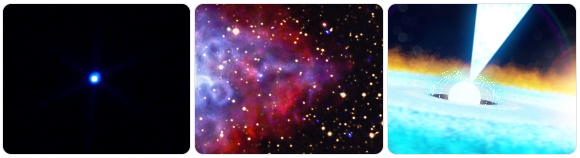
Quark and exotic stars are theoretical objects proposed beyond neutron stars, suggesting that matter might exist in even more extreme states. These stars have been suggested to help explain certain observational properties that standard neutron-star models struggle to account for. The core idea is that the pressure and density in a neutron star’s center could become so high that even neutrons might break apart into more fundamental components.
Quark stars are among the most discussed members of this theoretical class. In such stars, matter is thought to decompose into quarks—the constituents that make up protons and neutrons. This form of matter is often called “quark matter” and would exist in an extremely dense state. From the outside, quark stars might resemble neutron stars, but their internal structure could be fundamentally different.
One of the most studied candidates is RX J1856.5−3754. This object stands out because of its unusually smooth emission and its smaller-than-expected radius. X-ray observations have suggested that it cannot be fully explained by classic neutron-star models. For this reason, RX J1856.5−3754 is considered one of the stronger candidates that could potentially be a quark star.
Another group discussed under “exotic stars” includes dense stars that may contain unusual particle types or unfamiliar phases of matter in their interiors. In these objects, it has been proposed that, alongside neutrons, other particles or exotic matter phases could exist. Such bodies could represent a transitional state between neutron stars and black holes.
One candidate sometimes mentioned in this context is the compact star at the center of the 3C 58 supernova remnant. This object has drawn attention because of an apparent mismatch between its age and its temperature. Observations indicate that it may be cooling faster than expected, raising the possibility that an unusual phase of matter could exist in its interior.
Another notable object frequently examined in discussions of quark/exotic-star candidates is SAX J1808.4−3658. Its rapid rotation and its mass–radius constraints show properties that challenge standard neutron-star models. In particular, density estimates have suggested that the star’s interior composition could be unusual. For this reason, SAX J1808.4−3658 is often studied within exotic-star modeling.
Quark and exotic stars have not yet been confirmed with certainty. However, existing observations indicate that some neutron stars cannot be fully explained by standard models. These unresolved points strengthen the possibility that more extreme physical states may exist. As a result, quark and exotic stars have become one of the most active research areas in modern astrophysics.
Studying such stars is crucial not only for stellar evolution, but also for understanding the fundamental nature of matter. Conditions too extreme to be created in laboratories can arise naturally in these stars’ cores. In this way, quark and exotic stars offer unique research territory that connects particle physics with astrophysics.
In conclusion, quark and exotic stars represent possible structures that extend beyond neutron stars, pointing to the most extreme states matter may take. Although not yet definitive, observational data suggest that such objects could exist in the universe. Understanding them means understanding the limits of matter and how far the laws of physics can be pushed.