Irregular Galaxies
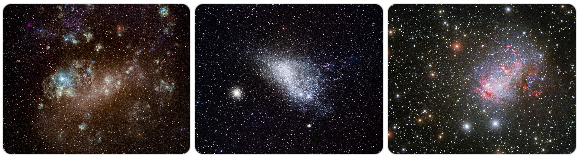
Irregular galaxies are galaxy types that do not have a clear, well-defined shape and do not display the orderly structures seen in spiral or elliptical galaxies. They lack symmetric arms, a central disk, or a smooth core structure. Their appearance is complex, fragmented, and uneven. For this reason, they are treated as a separate group in galaxy classifications.
This structureless appearance is often linked to external influences. Gravitational interactions with nearby large galaxies, tidal forces, and collisions can disrupt a galaxy’s internal order. In some cases, an irregular galaxy may have once had a more organized shape but lost it due to environmental effects.
These galaxies are often rich in gas and dust. They contain large amounts of interstellar gas, which allows star formation to remain active. However, star formation does not occur along distinct arms or in neatly organized regions; instead, it is spread across different parts of the galaxy. This further strengthens the galaxy’s scattered, patchy appearance.
One of the best-known examples of an irregular galaxy is the Large Magellanic Cloud. It lies near the Milky Way and interacts with it gravitationally. This interaction has played an important role in preventing the Large Magellanic Cloud from developing a strongly regular structure. Similarly, the Small Magellanic Cloud is another typical example of this class because of its irregular form.
Another important example is IC 10. IC 10 is notable for its active star-forming regions and, thanks to its dense gas content, it can produce many new stars in a relatively short time. This shows that irregular galaxies, despite their smaller sizes, can be highly dynamic in a cosmic sense.
Irregular galaxies are generally smaller than elliptical and spiral galaxies. However, this does not mean they are unimportant. On the contrary, irregular galaxies provide valuable natural examples for understanding early stages of galaxy evolution and how environmental effects can reshape galactic structures.
These galaxies clearly demonstrate the impact of galaxy interactions and gravitational forces on galactic form. The lack of a regular shape reveals that galaxies do not evolve under the same conditions everywhere in the universe. For this reason, irregular galaxies emphasize the importance of both galaxy diversity and cosmic environment.
In conclusion, irregular galaxies are important examples showing that galaxy formation and evolution are not always orderly or symmetric. Because they are gas-rich, actively forming stars, and highly sensitive to external influences, they play a key role in understanding how galaxies can change shape over time.