Supermassive Black Holes
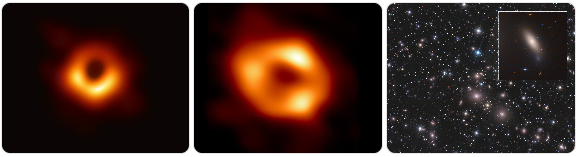
Supermassive black holes are black holes that can reach millions or even billions of solar masses. They are found in the centers of galaxies and play a fundamental role in the evolution of galactic structure. Today, it is thought that nearly every large galaxy contains a supermassive black hole at its core.
The masses of supermassive black holes are extraordinarily large compared with stellar-mass black holes. The diameter of their event horizons can exceed millions of kilometers. These black holes strongly affect nearby gas and stars. In particular, dense gas in galactic centers can flow inward to form an accretion disk, producing intense high-energy radiation.
The black hole at the center of the Messier 87 galaxy was the first black hole to be directly imaged in 2019. This image is historically significant because it revealed the bright ring structure around the event horizon. The mass of this black hole is about 6.5 billion solar masses, making it one of the best-known examples of the supermassive class.
Sagittarius A*, located at the center of the Milky Way, has a mass of about four million solar masses. Its image, released in 2022, directly showed that there truly is a black hole at our galaxy’s center. Sagittarius A* is a key reference point for understanding the dynamics of galactic centers.
The black hole in the center of the galaxy NGC 1277 is unusually large and makes up an extraordinary fraction of its host galaxy’s total mass. This provides important clues about how supermassive black holes are connected to galaxy evolution.
Supermassive black holes do not only influence their host galaxies; they can also release energy on intergalactic scales. In some active galactic nuclei, jets launched from the black hole can extend for thousands of light-years. These jets can affect a galaxy’s gas content and its rate of star formation.
In conclusion, supermassive black holes are the most powerful structures located in galactic centers and are key drivers of galactic evolution. Because of their mass, energy output potential, and environmental impact, they are among the most impressive cosmic objects in the universe.