How Do Black Holes Form?
The formation of black holes begins when gravity overcomes all other forms of physical resistance in matter. This process is not identical for every type of black hole. The formation mechanism depends on the object’s mass and the cosmic environment. But the basic principle is the same: a sufficiently large mass collapses irreversibly by overcoming its own internal pressure.
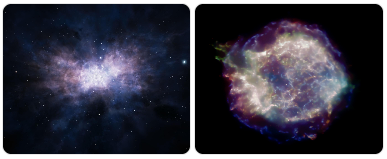
Stellar-mass black holes form at the end of the lives of massive stars. While a star produces energy through nuclear fusion in its core, it remains balanced against gravity. When its fuel is exhausted, that balance breaks down. In stars with at least about eight times the Sun’s mass, the core begins to collapse. The collapse happens suddenly and triggers a supernova explosion. If the remaining core is massive enough, it passes beyond the neutron-star stage and collapses completely; the result is a black hole.
The formation of supermassive black holes is more complex. These black holes reside in the centers of galaxies and can reach millions or billions of solar masses. Their origin is explained through two main processes. The first is the direct collapse of massive gas clouds in the early universe. The second is growth through mergers and accretion: smaller black holes can merge over time and gain mass. During galaxy mergers, the central black holes can also merge, increasing their mass.
How intermediate-mass black holes form is still an active research topic. These black holes sit between stellar-mass and supermassive black holes. One possible scenario is the merging of many stellar-mass black holes within dense star clusters. Another possibility is that larger early “seed” objects formed in the young universe and then grew over time.
The formation of primordial black holes is not linked to stars. They are hypothesized to have formed in the universe’s very first moments, shortly after the Big Bang, due to density fluctuations. While the universe was extremely hot, some regions may have become denser than others and collapsed directly. This hypothesis has not yet been confirmed.
A common point in black hole formation is the crossing of a critical mass threshold. Once this threshold is exceeded, matter collapses irreversibly under gravity. When the collapse completes, an event horizon forms and the system is defined as a black hole.
In conclusion, black holes do not have a single formation mechanism. The deaths of stars, gas collapse in galactic centers, black hole mergers, and early-universe conditions can all produce black holes of different masses. This diversity is fundamental to understanding how black holes are distributed in the universe and what roles they play.