Stellar-Mass Black Holes
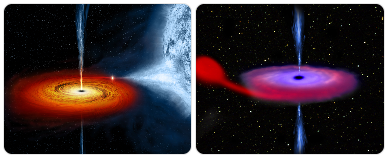
Stellar-mass black holes are the type of black hole that forms at the end of the lives of massive stars. Their masses typically range from a few solar masses to several tens of solar masses. Their formation is directly tied to stellar evolution and often follows a supernova explosion.
While a star produces energy through nuclear fusion in its core, it stays in balance against gravity. When its fuel is depleted, that balance breaks down. The star’s core collapses rapidly and the outer layers are blasted into space in a supernova explosion. If the remaining core mass is above a certain limit, a neutron star cannot form and matter collapses completely. This irreversible collapse is the birth of a stellar-mass black hole.
Stellar-mass black holes are often observed not in isolation, but as part of binary systems. In these systems, the black hole pulls material from a nearby star. The captured material does not fall straight in at first; it forms an accretion disk. This disk heats up to extreme temperatures and emits strong X-rays. The presence of black holes is often detected through this high-energy radiation.
Cygnus X-1 is one of the first strong black hole candidates discovered, and it is now confirmed to be a stellar-mass black hole. In this system, the black hole forms a binary pair with a massive star. As material flows from the star toward the black hole, intense X-ray emission is produced.
Another important example is V404 Cygni. In this system, the black hole accretes matter from a smaller star and sometimes shows sudden increases in brightness. Such outburst behavior arises from instabilities in the accretion disk and reveals the dynamic nature of stellar-mass black holes.
Stellar-mass black holes are thought to be quite common in the universe. In the Milky Way alone, there may be millions of stellar-mass black holes. However, most cannot be detected directly because they are not actively accreting material. For this reason, the number of observed stellar-mass black holes is far smaller than the likely true number.
In conclusion, stellar-mass black holes are dense remnants formed after the dramatic deaths of massive stars. Although their masses are small compared with supermassive black holes, they play a central role in astrophysical research because their strong gravity significantly affects nearby matter.