Emission Nebula
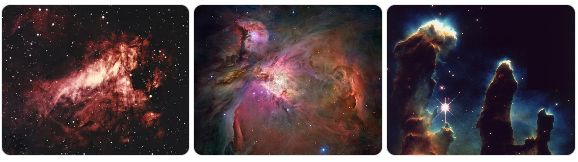
Emission nebulae are a type of nebula found in interstellar space that produce their own visible light. Their defining feature is that the gas within them glows after being energized by extremely hot and powerful nearby stars. Emission nebulae are commonly located in regions where star formation is actively ongoing, which is why they are considered among the most dynamic and changeable structures in the universe. Because they appear bright and colorful in visible light, they allow physical processes to be observed more directly.
For an emission nebula to shine, it must be exposed to high-energy stars in its vicinity. These stars are typically very massive and extremely hot. Their intense ultraviolet radiation ionizes the hydrogen gas within the nebula. During ionization, hydrogen atoms lose their electrons. Later, when electrons recombine with the atomic nucleus, energy is released at specific wavelengths. This released energy is what enables the nebula to generate its own light, producing the characteristic glow of emission nebulae.
The reddish and pink tones often seen in emission nebulae primarily come from hydrogen gas. Hydrogen is the most abundant element in the universe and forms the main component of these nebulae. When ionized hydrogen releases energy, it most commonly emits light in red wavelengths. Other elements such as oxygen and nitrogen contribute additional colors. As a result, an emission nebula is not a single-colored structure but instead displays a complex, layered appearance.
Emission nebulae are generally quite hot. The temperature of the gas within them can reach thousands of degrees. This high temperature keeps the material in constant motion. Gas flows, shock waves, and stellar winds gradually reshape the nebula over time. For this reason, emission nebulae are not fixed structures; over millions of years they evolve, expand, disperse, or are re-sculpted by the influence of newly formed stars.
One of the most important characteristics of these nebulae is their direct relationship with star birth. Within emission nebulae there are dense regions of gas and dust. Over time, gravity becomes dominant in these regions and the gas begins to collapse. The collapsing areas form the cores of new stars. Therefore, emission nebulae are not merely glowing clouds of gas, but cosmic nurseries where new stars are born. The Orion Nebula in the constellation Orion is one of the best-known examples where this process can still be observed today. Similarly, the Eagle Nebula displays a typical emission-nebula structure through its dense pillars of gas and its young star-forming regions.
Emission nebulae are most commonly found along the spiral arms of galaxies. Since spiral arms are the most active zones of star formation, it is no coincidence that emission nebulae are abundant there. These regions contain large amounts of gas and dust, and young stars quickly illuminate their surroundings, bringing emission nebulae into view. This makes emission nebulae an important observational tool for understanding the structure and evolution of galaxies.
The lifetime of an emission nebula is closely connected to the evolution of the stars inside it. The massive, hot stars that illuminate the nebula live relatively short lives. When they end their lives within a few million years, the intense radiation weakens and the nebula begins to lose its brightness. Over time the gas disperses into space, or it may transform into a different type of nebula under the influence of newly formed stars. For this reason, emission nebulae are temporary on cosmic timescales, yet extremely influential.
In conclusion, emission nebulae represent regions of exceptional activity in both energy and matter across the universe. Because they produce their own light, are directly linked to star birth, and help shape galactic structures, they are among the fundamental subjects of astronomical study. These nebulae provide unique natural laboratories for understanding how new stars form and how young stars transform their surroundings.