What Are Constellations?
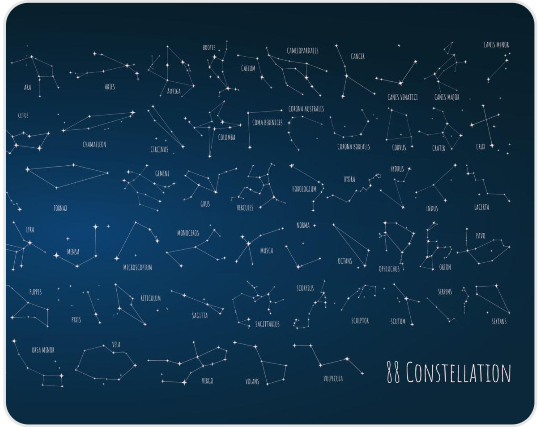
Constellations are regions of the sky defined by people who connected stars with imaginary lines after noticing that, from Earth, certain stars appear close to one another and form meaningful patterns. In space these stars are not physically bound to each other; they only seem aligned from the observer’s point of view. Even so, constellations have been one of the most fundamental ways of making sense of the sky for thousands of years.
From very early periods of human history, the sky was used for navigation, measuring time, and interpreting natural events. Repeating star patterns were noticed in the night sky, and meanings were assigned to them. Constellations are the product of this process of interpretation. Hunters, farmers, sailors, and travelers used these patterns as guides. For this reason, constellations are not only an astronomical concept but also a cultural one.
Constellations are not real physical structures. The stars within the same constellation can be located at very different distances from one another in the depths of space. Some stars are relatively close to Earth, while others are much farther away. However, the human eye cannot perceive this depth difference and sees the stars on a two-dimensional “sky plane.” This is one of the main reasons constellations can form in our perception.
The constellations defined in the sky are not random shapes. Over time, certain boundaries and names became standardized. Today, the sky is divided into a fixed number of constellations, and each one represents a defined area of the sky. These areas are used in star charts to divide the sky into sections and to describe the positions of celestial objects. In this sense, constellations also serve a functional role in modern astronomy.
Constellations make the sky easier to learn and remember. The sky is extremely vast and complex. In an environment containing billions of stars, forming recognizable patterns allows the human mind to treat the sky like a map. Thanks to constellations, the sky becomes a structured and readable system rather than a chaotic mass of stars.
Another important feature of constellations is their relationship with the seasons. Because of Earth’s motion around the Sun, different constellations become more prominent at different times of the year. In the past, this was used to track the seasons. The rising or setting of certain constellations served as indicators of planting and harvest times for agricultural societies.
Constellations were also used for navigation. In particular, some constellations behave like stable reference points in the sky. This was extremely important before modern tools such as compasses existed. Being able to determine direction by looking at the sky was a vital skill for long journeys.
In conclusion, constellations do not represent a physical unity among stars, but rather the way the human mind perceives and organizes the sky. Although they are imaginary structures scientifically, they have been central elements of humanity’s relationship with the sky throughout history. Understanding constellations means understanding not only stars, but also humanity’s effort to comprehend the universe.