K-Type Stars
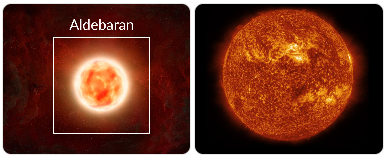
K-type stars are a group of stars that are slightly cooler than the Sun in terms of temperature and brightness, and they typically appear in more orange tones. In spectral classification they lie between G-type and M-type stars, and therefore represent an important transition region within stellar diversity. K-type stars are quite common in the universe and make up a significant portion of the Milky Way’s stellar population. Because they are not as luminous as the Sun, they are not easily distinguished from very great distances; however, relatively nearby K-type stars can be identified with the naked eye by their orange-tinged color.
The surface temperatures of K-type stars generally fall in the range of about 3,700 to 5,200 degrees. This makes them hotter than M-type red dwarfs but cooler than G-type stars. Because their temperatures are lower, a substantial portion of the light they emit shifts toward longer wavelengths, causing the star’s color to appear yellowish-orange. This color is one of the most visually distinctive markers of the K class within the spectral system.
K-type stars are not uniform in size and mass. Within this class, there can be both main-sequence stars with masses close to the Sun’s and K-type giant stars that have expanded and become much brighter. For this reason, the term “K-type” indicates the star’s temperature band, but it does not by itself determine which stage of stellar life the star is in. Still, K-type main-sequence stars are generally thought of as stars that are slightly less massive than the Sun, less luminous, and longer-lived.
Among well-known K-type stars in the sky, Aldebaran in the constellation Taurus is one of the famous examples that stands out with its distinctly orange color. Similarly, Arcturus in the constellation Boötes is also easy to recognize by its color; it is one of the brightest stars in the night sky and is often mentioned among stars associated with the K group in spectral classification. Such examples show that the “orange-toned” appearance of K-type stars is not merely a theoretical detail but also something that has a clear counterpart in naked-eye observations.
K-type stars are also a special area of research in terms of planetary systems. Because these stars are brighter than M-type stars, observational study of planets around them can be more favorable in some cases. At the same time, their ability to remain stable for longer periods compared with the Sun can allow planetary systems to develop in a steady way over long timescales. For this reason, K-type stars are frequently studied in topics such as star–planet interactions and the evolution of planetary systems.
The internal structures, energy-production rates, and lifetimes of K-type stars are directly related to their masses. Main-sequence stars in this class tend to consume their hydrogen fuel more slowly than the Sun. This allows them to remain on the main sequence for a longer time. Because their masses are not extremely high, their late evolutionary stages typically proceed by expanding into giant stars, shedding their outer layers into space, and eventually leaving behind a dense core. This general pathway is the typical line of evolution for low- and intermediate-mass stars.
K-type stars are not always calm and static. Some can show magnetic activity, starspots, and flare events. Such activity varies depending on the star’s age, rotation rate, and magnetic-field structure. This indicates that K-type stars are not merely “mild” stars; they can display noticeable changes at times due to their internal dynamics and surface activity.
In conclusion, K-type stars form an important part of spectral classification and occupy an intermediate temperature region within stellar diversity. Their orange-tinged colors, relatively long lifetimes, and widespread nature make them significant both in sky observations and in the study of star–planet systems. Understanding K-type stars means understanding the role of stars that are cooler than the Sun but warmer than M-type red dwarfs in the universe.