Vector Derivation of Kepler's Laws from Newtonian Gravitation and the Analytic Determination of Orbital Parameters
Subject: Celestial Mechanics and Keplerian Orbit Theory
Summary: The paper derives Keplerian motion vectorially by reducing the Newtonian two-body problem to an equivalent one-body problem with reduced mass. Conservation of linear momentum, specific angular momentum, mechanical energy, and the Laplace–Runge–Lenz eccentricity vector is used to show that trajectories are planar conic sections focused on the attracting mass and described by r = p/(1 + e cos ν). From the same invariants it obtains Kepler’s second and third laws, the vis-viva relation v² = μ(2/r − 1/a), circular-orbit stability, and the six classical orbital elements. The work also applies the formalism to the Earth–Sun system, Hohmann transfers, binary-star mass determination, an exoplanet radial-velocity example, and numerical solution of Kepler’s equation by Newton–Raphson iteration.
Purpose: The aim is to present a unified analytic derivation of Kepler’s laws from Newtonian gravitation using geometric constants of motion. It also shows how standard orbital parameters and practical astrodynamical results follow from the same vector framework.
Target Audience: It is intended for graduate students, researchers, and advanced undergraduates in celestial mechanics, astrophysics, space engineering, and classical mechanics.
Date: 25-09-2026
Analytic Derivation of the Saha-Boltzmann Equations, the Grey Atmosphere Model and the Eddington Approximation
Subject: Radiative Transfer and Stellar Atmospheres
Summary: The paper analytically derives the relations among mean intensity, flux and radiation pressure from angular moments of the specific intensity, and then obtains the Boltzmann excitation formula and the Saha ionization equation from equilibrium counting arguments. Applied to hydrogen at fixed electron pressure, the derivation explains why Balmer absorption is strongest near A-star temperatures, around 10,000 K. For a plane-parallel grey atmosphere, it derives the transfer equation, optical depth, formal solution and moment equations, leading to the Eddington temperature law T⁴ = 3/4 Teff⁴(τ + 2/3); hence T(τ = 2/3) = Teff and the surface temperature is T(0) ≈ 0.84 Teff. Contribution functions, the Eddington-Barbier relation, diffusion transport and the link between optical depth and gas pressure are clarified through worked numerical examples and observational tests.
Purpose: The paper aims to present a self-contained analytic derivation of the Saha-Boltzmann equations, the classical grey atmosphere model and the Eddington approximation. It also identifies the assumptions that make these results useful and the limitations that restrict their applicability.
Target Audience: It is intended for advanced students, researchers and instructors working on stellar atmospheres, spectral formation and radiative transfer.
Date: 25-09-2026
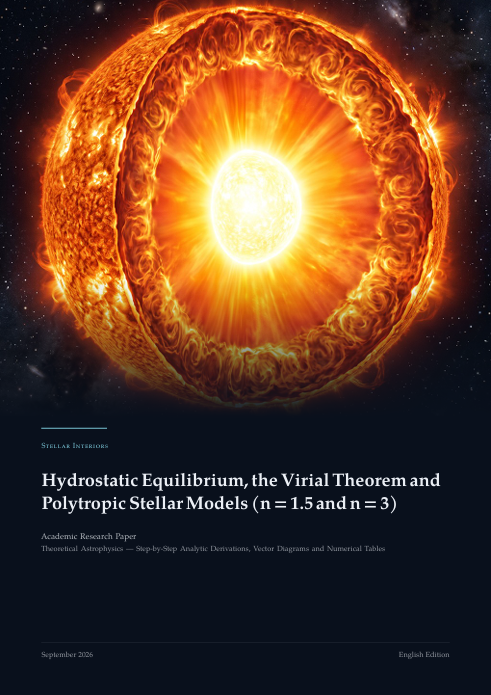
Hydrostatic Equilibrium, the Virial Theorem and Polytropic Stellar Models (n = 1.5 and n = 3)
Subject: Stellar Structure, the Virial Theorem and Polytropic Models
Summary: The paper constructs the Newtonian theory of stellar structure from local momentum conservation to the equations of hydrostatic equilibrium and mass continuity, deriving central-pressure estimates and the scalar virial theorem for gaseous stars. Using the virial theorem, it obtains a Kelvin-Helmholtz time for the Sun of ≈ 3 × 10⁷ yr and a characteristic interior temperature of order ≈ 10⁷ K. With the polytropic equation of state P = Kρ^(1+1/n), it derives the Lane-Emden equation, presents analytic solutions for n = 0, 1, 5, and gives numerical constants for n = 1.5 and n = 3: ξ₁ ≈ 3.65375, −ξ₁²θ′(ξ₁) ≈ 2.71406, and ρc/ρ̄ ≈ 5.99; ξ₁ ≈ 6.89685, −ξ₁²θ′(ξ₁) ≈ 2.01824, and ρc/ρ̄ ≈ 54.18. The mass-radius relation is derived, highlighting the exceptional n = 3 polytrope in which mass is independent of radius at fixed K, a result connected to relativistic white dwarfs and the Chandrasekhar limit ≈ 1.44 M☉.
Purpose: The aim is to derive the fundamental equations of hydrostatic stellar models and the virial theorem while emphasizing their physical interpretation. The paper also clarifies the scope and limitations of polytropic models in applications to stellar evolution, white dwarfs and the Eddington standard model.
Target Audience: It is intended for advanced undergraduate or graduate students and researchers in astrophysics, stellar structure and theoretical physics.
Date: 25-09-2026
The Gamow Peak, Quantum Tunnelling Probability and the Reaction Kinetics of the p-p Chain: An Analytic Treatment
Subject: Thermonuclear Reaction Kinetics in Stellar Plasmas
Summary: The paper presents an analytic treatment of the proton-proton chain, the dominant source of solar luminosity, using the Gamow peak, WKB tunnelling, the astrophysical S-factor, and Maxwell-Boltzmann averaging. It derives the Coulomb-barrier penetration factor exp(-2πη), its Gaussian-units form exp(-b/√E), the saddle-point energy E₀ = (bkT/2)^(2/3), and the Gamow-window width Δ = 4√(E₀kT/3). These results are connected to solar-core scales, screening corrections, temperature exponents, equilibrium abundances of deuterium and ³He, and the competition among the ppI, ppII, and ppIII branches. The analysis also relates pp-chain kinetics to neutrino spectra and observational tests, emphasizing transparent derivations and physical interpretation.
Purpose: The aim of the paper is to derive why the pp chain proceeds slowly but effectively in low-energy stellar plasmas from quantum tunnelling and thermal averaging principles. Rather than merely quoting standard formulae, it seeks to make their physical origin analytically clear.
Target Audience: The intended audience is graduate students, researchers, and advanced readers in stellar astrophysics, nuclear astrophysics, and plasma physics.
Date: 25-09-2026
Relativistic Electron Degeneracy Pressure and the Analytic Derivation of the Chandrasekhar Mass Limit
Subject: Stellar Evolution and Degenerate Matter Physics
Summary: The paper derives the electron degeneracy equation of state that supports white dwarfs through the quantum pressure of a cold degenerate electron gas rather than thermal pressure. Starting from phase-space counting in a Fermi sphere, it obtains the Fermi momentum, the exact zero-temperature pressure integral, the non-relativistic and ultra-relativistic limits, and Chandrasekhar’s closed equation of state in terms of x = pF/(me c). Combined with hydrostatic equilibrium and the Lane–Emden equation, the n = 3/2 polytrope gives the white-dwarf mass–radius relation R ∝ M⁻¹/³, while the n = 3 polytrope gives a radius-independent limiting mass. Using the Lane–Emden constant ξ₁²|θ′(ξ₁)| = 2.01824, the paper obtains MCh = 5.83 μe⁻² M☉, or MCh ≈ 1.457 M☉ for carbon–oxygen matter with μe = 2.
Purpose: The aim is to provide a self-contained analytic derivation of the Chandrasekhar mass limit from electron degeneracy pressure. It also clarifies the physical interpretation of the result and discusses numerical examples, observational tests, stability criteria, and corrections.
Target Audience: The intended audience is advanced students, researchers, and instructors working on stellar structure, compact objects, astrophysics, and quantum statistical mechanics.
Date: 25-09-2026
Derivation of the Tolman-Oppenheimer-Volkoff (TOV) Equilibrium Equation in General Relativity and Neutron Star Structure
Subject: General Relativity, Compact Stars, and Neutron Star Structure
Summary: The paper derives the TOV equation for a static, spherically symmetric perfect-fluid star from the Einstein field equations and local stress-energy conservation in a self-contained way. It explicitly obtains the mass equation, gravitational-potential equation, and pressure equation, then combines them into the factored TOV form displaying pressure inertia, pressure self-gravity, and curvature amplification. Using the uniform-density Schwarzschild interior solution, it shows that the central pressure diverges as 2GM/(Rc²) → 8/9 and gives the Buchdahl bound R > 9GM/(4c²). The discussion connects these results to neutron-star equations of state, compactness, gravitational redshift, binding energy, numerical integration, and observed ≈ 2 M☉ pulsars.
Purpose: The paper aims to clarify the geometrical and physical origin of the TOV equation and to show how it governs neutron star structure. It also quantifies key limits through the uniform-density model, the Buchdahl bound, and observational diagnostics.
Target Audience: It is intended for advanced students, researchers, and practitioners working on general relativity, astrophysics, compact stars, and numerical stellar-structure modelling.
Date: 25-09-2026
Derivation of the Schwarzschild Metric and the Analysis of Geodesic Motion near the Event Horizon
Subject: General Relativity and Black-Hole Geometry
Summary: The paper derives the Schwarzschild metric from a static spherically symmetric line element by explicitly computing the nonzero Christoffel symbols and Ricci tensor components and solving the vacuum Einstein equations. The integration constant is fixed through the Newtonian weak-field limit, giving the Schwarzschild radius r_s = 2GM/c². Using the geodesic Lagrangian, it obtains conserved energy and angular momentum, constructs effective potentials for massive particles and photons, and identifies the ISCO at 6GM/c² = 3r_s, the marginally bound orbit at 4GM/c² = 2r_s, the photon sphere at 3GM/c² = 1.5r_s, and the shadow scale b_c = 3√3GM/c² ≈ 2.60r_s. The coordinate singularity at the event horizon is removed with ingoing Eddington-Finkelstein coordinates, and observable tests such as gravitational redshift, perihelion precession, light deflection, Shapiro delay, and EHT angular scales are discussed quantitatively.
Purpose: The paper aims to derive the Schwarzschild solution from first principles and systematically analyze the physical consequences of particle and photon geodesics near the event horizon. It also connects the theoretical results to observational tests of general relativity.
Target Audience: It is intended for graduate students, researchers, and instructors working on general relativity, black-hole physics, compact objects, and relativistic astrophysics.
Date: 25-09-2026
The Jeans Equations, Galactic Rotation Curves and the NFW Dark Matter Potential Profile
Subject: Galactic Dynamics and Dark Matter Halo Modelling
Summary: The paper derives the velocity moments and Jeans equations from the collisionless Boltzmann equation, showing how the mass distribution of galaxies can be inferred from stellar and gas kinematics. It treats the spherical Jeans equation with velocity anisotropy, the cylindrical Jeans equation with asymmetric drift, and the local vertical Jeans equation used to estimate the dark-matter density near the Sun. In the context of galactic rotation curves, it explains the Keplerian decline v_c ∝ r⁻¹ᐟ² for a point mass, the exactly flat curve v_c = √2 σ for a singular isothermal sphere, and the need for dark halos in spiral galaxies. For the NFW profile, it gives key quantitative results including M(<r) = 4πρ_s r_s³[ln(1+x) − x/(1+x)], the inner slope ρ ∝ r⁻¹, the outer slope ρ ∝ r⁻³, and the maximum circular speed occurring at r ≈ 2.16 r_s.
Purpose: The aim is to present Jeans modelling as a practical mass-estimation framework starting from its phase-space foundations. It also aims to derive explicitly how the NFW dark-matter profile connects to rotation curves and halo parameters.
Target Audience: It is intended for advanced undergraduate and graduate students, as well as researchers interested in galactic dynamics, astrophysics, and dark-matter halo modelling.
Date: 25-09-2026
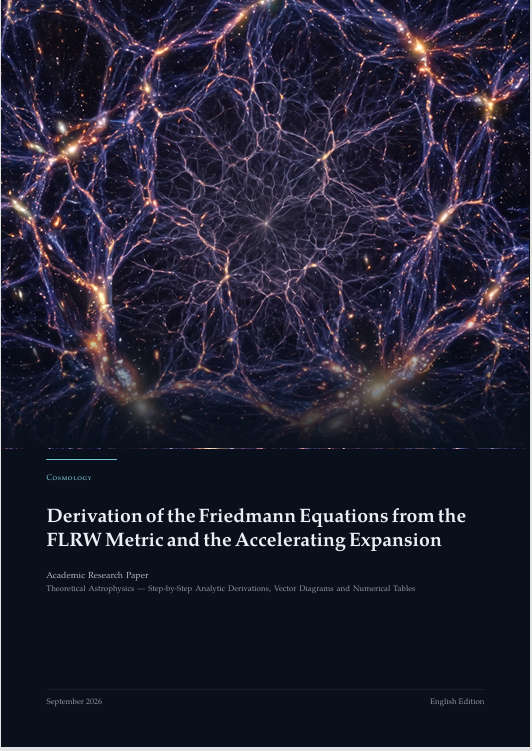
Derivation of the Friedmann Equations from the FLRW Metric and the Accelerating Expansion
Subject: Cosmology and General Relativity
Summary: The paper derives the Friedmann equations step by step from the FLRW metric using explicit Christoffel symbols, Ricci components, and the perfect-fluid stress-energy tensor in the comoving frame. It obtains the fluid equation from covariant energy conservation and shows its equivalence to combining the time derivative of the first Friedmann equation with the acceleration equation. It then discusses equations of state, density parameters, analytic scale-factor solutions, the age integral, the deceleration parameter, luminosity distances, and the Type Ia supernova Hubble diagram. Worked examples with standard cosmological parameters give a cosmic age of ≈ 13.5 billion years, a critical density of ≈ 9.2 × 10⁻²⁷ kg/m³, an acceleration-transition redshift of ≈ 0.67, and a luminosity distance of ≈ 6.6 Gpc for z = 1.
Purpose: The aim is to derive the dynamical equations of a homogeneous and isotropic universe directly from geometric principles and connect them to observational cosmology. It also situates accelerated expansion, dark energy, and the Hubble tension within this framework.
Target Audience: It is intended for graduate students, researchers, and advanced physics students with introductory to intermediate knowledge of general relativity and cosmology.
Date: 25-09-2026
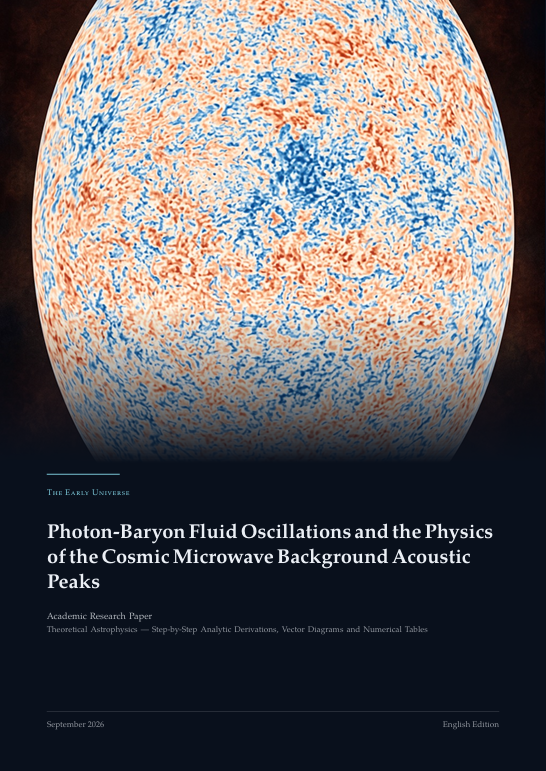
Photon-Baryon Fluid Oscillations and the Physics of the Cosmic Microwave Background Acoustic Peaks
Subject: Cosmology and Cosmic Microwave Background Physics
Summary: The paper derives the standard analytic theory of acoustic oscillations in the pre-recombination photon-baryon plasma in the tight-coupling limit. Using the Saha equation, it shows why hydrogen recombination occurs near T ≈ 3000 K, far below the ionization scale 13.6 eV/k_B. It derives the coupled photon-baryon oscillator in a Newtonian gravitational potential, obtains the sound speed c_s = c/√(3(1+R)), and solves for the effective temperature perturbation Θ₀+Ψ. The sound horizon sets the harmonic wavenumbers kₙ = nπ/r_s, baryon loading enhances compressional peaks, and projection to angular multipoles places the first acoustic peak near ℓ ≈ 220.
Purpose: The aim is to explain the physical origin of the CMB acoustic peaks and connect their observed positions, heights, damping, and polarization to recombination microphysics and cosmological parameters within a self-contained analytic framework.
Target Audience: It is intended for graduate students, researchers, and advanced physics readers interested in cosmology, early-Universe physics, and the theoretical foundations of CMB observations.
Date: 25-09-2026
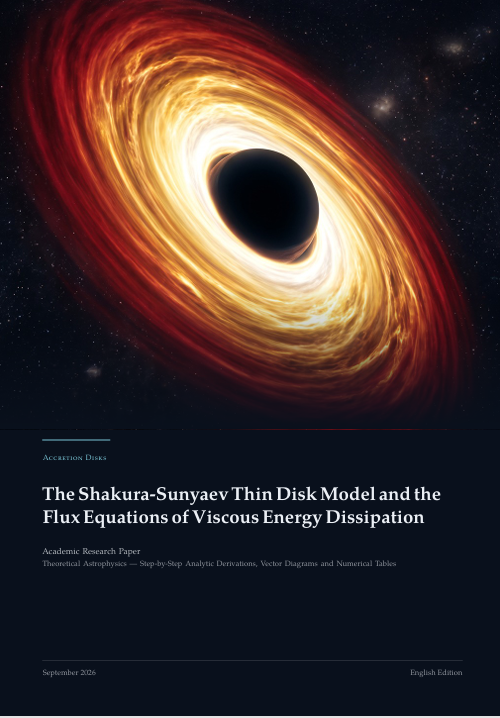
The Shakura-Sunyaev Thin Disk Model and the Flux Equations of Viscous Energy Dissipation
Subject: Astrophysical Accretion Disks and Viscous Transport
Summary: The paper derives the geometrically thin, optically thick Shakura-Sunyaev accretion disk from gravitational energy scales, the Eddington limit, Keplerian shear, and vertically integrated conservation laws. With a zero-torque inner boundary, the steady solution gives νΣ = Ṁ/(3π)[1 − (Rin/R)^(1/2)] and the viscous flux F(R) = 3GMṀ/(8πR³)[1 − (Rin/R)^(1/2)], leading to Teff = (F/σ)^(1/4). The bolometric luminosity is L = GMṀ/(2Rin), implying a Newtonian efficiency η ≈ 0.083 for Rin = 6GM/c², while the multi-colour blackbody spectrum has the characteristic intermediate-frequency scaling Lν ∝ ν^(1/3). The discussion extends to the α prescription, hydrostatic scale height, the surface-density diffusion equation, standard radial scalings, and worked estimates for cataclysmic variables, X-ray binaries, and active galactic nuclei.
Purpose: The paper aims to build the Shakura-Sunyaev thin disk model from first principles and show how viscous dissipation yields the observable flux, temperature, luminosity, and spectral relations. It also clarifies the model’s physical interpretation, applications, and limitations.
Target Audience: This entry is intended for graduate students and researchers in astrophysics, high-energy astrophysics, compact objects, and accretion physics.
Date: 25-09-2026
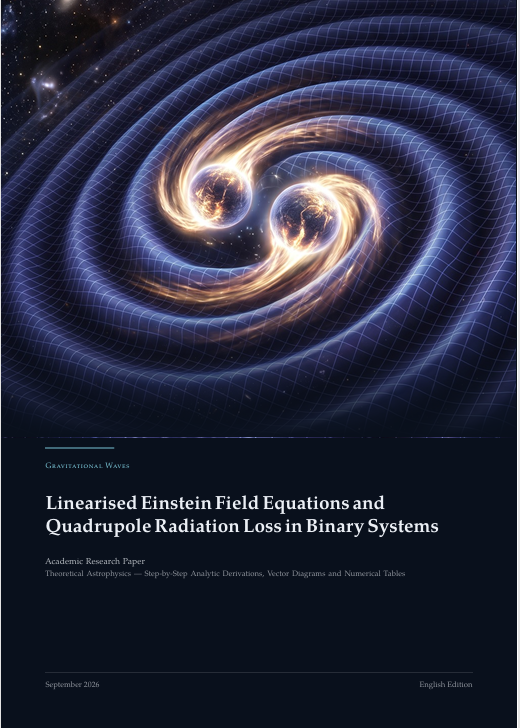
Linearised Einstein Field Equations and Quadrupole Radiation Loss in Binary Systems
Subject: General Relativity and Gravitational-Wave Astrophysics
Summary: Starting from the weak-field metric, the paper derives the linearised Einstein field equations in Lorenz (harmonic) gauge, obtains the transverse-traceless (TT) degrees of freedom of vacuum plane waves and connects them to the measurable tidal strain in freely falling detectors. The retarded solution of the wave equation is expanded for slowly moving isolated sources, yielding the quadrupole waveform and the quadrupole luminosity formula. The results are specialised to Newtonian compact binaries: for a circular orbit the power loss, orbital decay, coalescence time t_c = (5/256) c⁵a₀⁴/[G³m₁m₂(m₁+m₂)], chirp-mass dependence and frequency evolution are derived; eccentric corrections are given in Peters' form and linked to the Hulse–Taylor pulsar test through f(0.617) ≈ 11.8. Worked estimates give an observed-to-predicted Ṗ_b ratio ≈ 0.997 for PSR B1913+16, and for GW150914 a chirp mass ≈ 28 M☉, peak strain ~10⁻²¹ and radiated energy ~3 M☉c².
Purpose: The aim is to present the weak-field derivation of gravitational waves in general relativity as a traceable chain from linearisation to the quadrupole formula, and to show how these results apply to energy loss in binary systems and to modern detector observations. Gauge issues, the domain of validity and the relation to post-Newtonian and numerical-relativity waveform modelling are also discussed.
Target Audience: Advanced undergraduate and graduate students, researchers and instructors working on general relativity, gravitational-wave astronomy and compact binary systems.
Date: 25-09-2026